
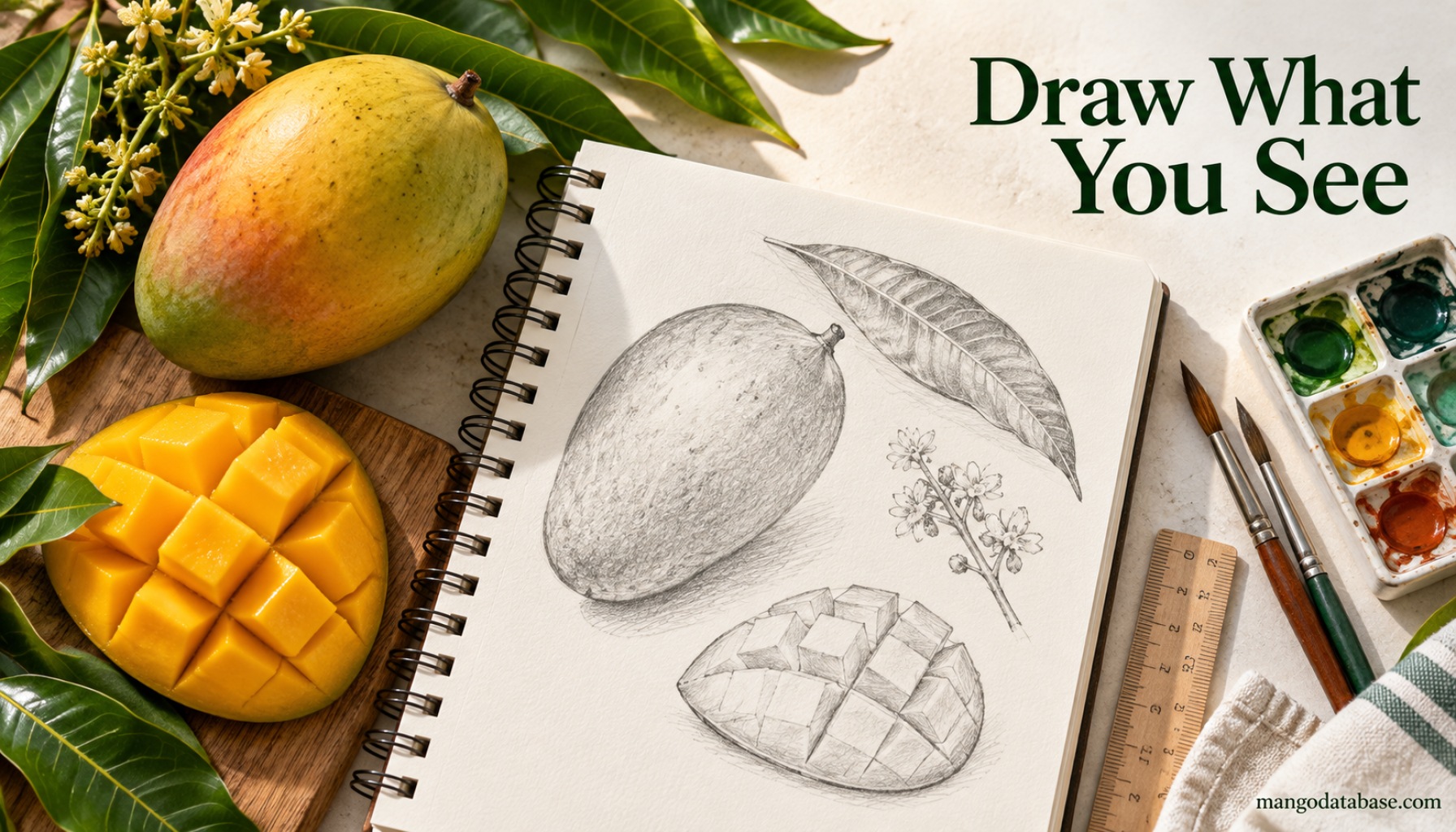
Set a mango on a table and it immediately offers an appealing subject: an uneven curve, a patch of blush, a quiet transition from green to yellow. A still life can celebrate those qualities freely. A botanical record asks an additional question: could someone learn something dependable about this particular fruit from the drawing? The distinction is not about artistic prestige. It is about making clear what you observed and what you chose to simplify.
There is a useful precedent in the USDA Pomological Watercolor Collection. Its fruit images were created as records and illustrations, not merely decoration. The collection includes work produced between 1886 and 1942. Looking at such material can sharpen an appreciation for measured observation, but a contemporary study need not imitate a historical plate or borrow an existing composition to become informative.
Begin with a specimen record before the first pencil line. Write the date, where the fruit came from, the name supplied with it, and whether that name is independently supported. Describe its condition: firm, yielding, recently cut, or visibly shriveled. If it was purchased as an unnamed mango, say so. A graceful illustration does not transform a seller's uncertain identification into a verified cultivar, and surface color alone is an unreliable substitute for a complete identity record.
Choose views that answer different questions. A broad side view may show curvature, while the opposite side reveals asymmetry. An end view can clarify the outline around the stem attachment. Measure the actual fruit and include a scale or dimensions rather than relying on a viewer's guess. Keep the measurement method consistent. If you enlarge a small detail, label that change so a close study of a lenticel is not mistaken for the scale of the whole fruit.
Color needs similar honesty. Work in steady light, and avoid moving between strong sun and differently colored indoor lamps while matching the same patch. Record a blush only where it exists. Do not smooth away a scar or intensify the flesh merely to make the specimen more attractive. Photographs taken alongside the drawing can preserve temporary conditions, although cameras and screens introduce their own changes. Neither medium should be treated as an infallible color standard without appropriate controls.
A cut view introduces details that the intact outline cannot reveal. Plan the section before cutting and photograph it promptly if browning or drying may alter the appearance during a long session. Note the orientation of the cut. Show flesh and seed relationships as observed rather than adding an idealized interior from memory. If a feature is obscured, leave it unresolved or annotate the limitation. An incomplete but accurate observation is more useful than a polished invented one.
The National Agricultural Library's Deborah Griscom Passmore collection offers another route into the work of a professional fruit illustrator. Studying originals can suggest questions about selection, detail, and presentation without requiring you to reproduce their imagery. For your own page, keep the drawing and field notes connected by a simple specimen number. Store the original image file separately from social-media versions with decorative text or heavy compression.
When the study is finished, read its caption as critically as the drawing. Does it identify a single observed specimen, or does it accidentally claim to represent every fruit of a cultivar? Have you distinguished supplied names from verified ones? A good botanical study can be beautiful and modest at the same time. Its lasting value lies in leaving another observer enough detail to understand the fruit you saw, including the limits of what you could record.
Leave a comment