

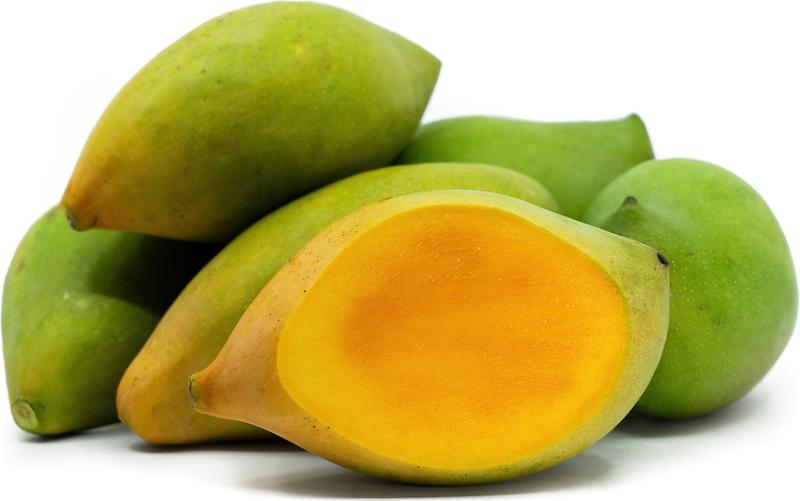
About Totapuri
Totapuri is a traditional mango cultivar from southern India, where it has been cultivated under several regional names, including Bangalora, Sandersha, Kili Mukku, and Collector. Its most recognizable feature is the elongated fruit with a prominent curved, beak-like tip, giving rise to the name Totapuri and regional names associated with a parrot's face or beak. The variety is widely grown in southern Indian mango-producing regions and has long been valued for its commercial usefulness. Unlike cultivars grown primarily for exceptional fresh-eating sweetness, Totapuri has become particularly important for mango pulp, juice, nectar, preserves, and other processed products. Its firm flesh, substantial fruit size, and comparatively good keeping qualities have helped establish it as an important processing cultivar.
Totapuri also has a documented history outside India. According to the cultivar descriptions published in The Mango: Botany, Production and Uses, the variety was introduced into Florida under the name Sandersha in 1901 and was imported again under the name Totapuri during the early 1960s. Its importance to mango collectors extends into breeding history: Totapuri was recorded as the seed parent of the Florida cultivars Anderson and Brooks, with Brooks subsequently becoming the seed parent of Kent. This gives Totapuri an indirect historical connection to one of the most widely recognized Florida-origin mangoes. Although the precise date of Totapuri's original selection in India and the identity of its first grower are not documented, its numerous regional names reflect its long-established place in southern Indian horticulture.
The fruit is oblong, with a rounded base and a distinctive pointed or curved beak. Its skin develops greenish-yellow to golden-yellow coloration, sometimes accompanied by a pinkish or reddish blush. The flesh is firm, moderately juicy, yellow, and fibrous, with mild sweetness, noticeable acidity, and a somewhat spicy flavor. Published fruit measurements vary considerably: one Indian scientific study recorded an average weight of approximately 14 ounces, while an established horticultural reference described larger fruit weighing approximately 1.8–2.4 pounds. The tree is vigorous, medium-sized, and spreading, with an open canopy. Totapuri is generally regarded as productive and regularly bearing, although heavy rainfall near ripening can cause fruit cracking.
For mango collectors, Totapuri is valuable because it represents a different side of mango history from the intensely sweet dessert cultivars. It is a recognizable heritage variety with documented international movement, multiple regional names, and a meaningful connection to Florida mango breeding. Its commercial importance also illustrates how mango cultivars are selected not only for fresh flavor but for firmness, processing suitability, productivity, and keeping quality. Totapuri remains an interesting addition to collections focused on Indian mango diversity, historic cultivars, and the ancestry of modern Florida mangoes.
R. J. Knight Jr., R. J. Campbell, and I. Maguire — The Mango: Botany, Production and Uses (2009), Chapter 3: Totapuri was imported into Florida as Sandersha in 1901 and again as Totapuri during the early 1960s. The cultivar is documented as the seed parent of Anderson and Brooks, and Brooks is identified as a seed parent of Kent. The authors describe Totapuri as a vigorous, medium-sized tree with a spreading canopy, regular production, and fruit susceptible to cracking during heavy rain near ripening.
Vijayanand, Deepu, and Kulkarni — Journal of Food Science and Technology (2015): A scientific comparison of Totapuri, Mallika, and Sindura mangoes recorded an average Totapuri fruit weight of approximately 14 ounces, pulp content of 70.8%, and relatively firm flesh. The research demonstrated Totapuri's suitability for processed mango products, including nectar and canned slices.


Photo Gallery
Add Your ImageNo additional photos yet.
Video Gallery
Member Descriptions Add Your Description
No member descriptions yet.
Similar Varieties
No similar varieties have been recorded yet.