A pedigree records the ancestry of a plant or breeding selection. For mango cultivars, the seed parent may be known while the pollen parent remains uncertain, especially when seed was collected from an open-pollinated tree. Historical accounts, labels, and genetic analyses provide different kinds of evidence and can disagree. State uncertainty clearly instead of turning a reported association into a proven cross. A cultivar's flavor or fruit shape alone is not a reliable pedigree test.
Phenotype is the set of observable characteristics of an organism resulting from its genotype interacting with its environment. Mango fruit size, skin appearance, growth habit, and seasonal performance are examples that can vary with growing conditions. Two trees with the same scion genotype may therefore look somewhat different in different locations. When identifying a cultivar or comparing selections, use multiple observations and reliable provenance rather than assuming one photograph or one unusual crop establishes genetic difference.
Piney flavor describes a resinous, pine-like, or sometimes turpentine-like note perceived in mango aroma and taste. It is a sensory description, not automatically evidence of contamination, immaturity, or an inferior cultivar. The strength and balance of aromatic notes vary with the fruit and its ripeness, and people differ in their preferences. Compare sound fruit at a suitable eating stage, and distinguish a normal resinous note from sour fermentation, mold, or another sign that a fruit should not be eaten.
Plashing is an older term associated with interlacing or laying branches in hedge work and is sometimes used alongside pleaching. It does not describe a separate mango propagation method. Interwoven mango branches can rub, shade one another, or create difficult picking conditions, so the technique should not be confused with deliberate grafting. A grower wanting several cultivars on one tree needs compatible grafts and balanced branch management rather than merely weaving different trees together.
Pleaching is training and interweaving branches to form a screen or other living structure. Adjacent branches may eventually join where tissues make suitable contact, but simple interweaving does not guarantee a functional graft. Mangoes are generally trained for light, access, airflow, and safe branch structure rather than as dense pleached barriers. Treat references to this technique as a landscape-training concept, not a recommended way to combine cultivars or a substitute for a properly made graft.
Pollination is the transfer of pollen to a flower's receptive stigma. Mango panicles bear male flowers and bisexual flowers, and insects such as flies and bees can help move pollen between them. A mango can often set fruit without a second cultivar, but pollination is only one step: fertilization, weather, disease, and the tree's resources also influence retention. Protect useful flower visitors and avoid interpreting every fallen flower as evidence that the tree needs a pollination partner.
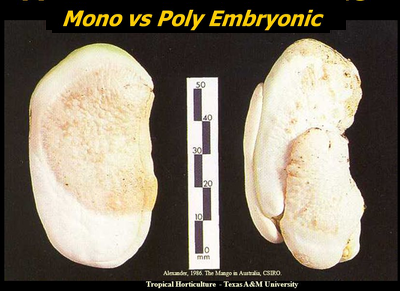
Polyembryonic describes a seed with multiple embryos. Mango seeds of this type can contain nucellar embryos derived from the mother tree's tissue as well as a sexually produced embryo; not every embryo necessarily survives or emerges. Nucellar seedlings can preserve the maternal genotype, but a sprout cannot be identified reliably as clonal merely because it is first, tallest, or strongest. This distinction matters when selecting rootstocks or attempting true-to-type seed propagation. A verified graft remains the clearest way to obtain a named cultivar.
Read the mango seed FAQ
Precocity is a tendency to reach reproductive activity relatively early. In mango descriptions it may refer to a cultivar or a grafted tree that flowers and fruits at a young age under suitable conditions. It is a comparative trait, not a promise of a crop in a fixed year after purchase. A very young tree carrying fruit can also sacrifice establishment and branch development, so early flowering should be evaluated alongside tree strength rather than treated as the only sign of quality.
To prune is to remove selected shoots, branches, or other plant parts to improve structure, access, health, or canopy size. Mango pruning often follows harvest so new shoots can develop and mature before the next flowering period, although climate, cultivar timing, and damaged wood can change the decision. Unlike a deciduous tree, mango should not automatically be pruned according to a winter-dormancy rule. Use deliberate cuts and avoid severe, repeated topping that removes productive canopy.