
This site contains affiliate links for which we may be compensated.

Mango Database
Mangoes in a sunlit tropical orchard

Mango Glossary

Understand the language of mango growing, one term at a time.

Explore Mango Terminology

Browse definitions and growing concepts to expand your mango knowledge.

Showing 1–7 of 11 terms

Fertilization

Fertilization in plant reproduction is the union of reproductive cells following successful pollen-tube growth. It differs from fertilizing a tree with nutrients, even though everyday language uses similar words. In mangoes it leads to development of a sexually produced embryo and supports normal seed and fruit development. Pollination can occur without successful fertilization, and a fertilized flower can still lose its fruitlet later. Consider these separate stages when asking why a heavily flowering tree did not produce a crop.
Read more about Fertilization
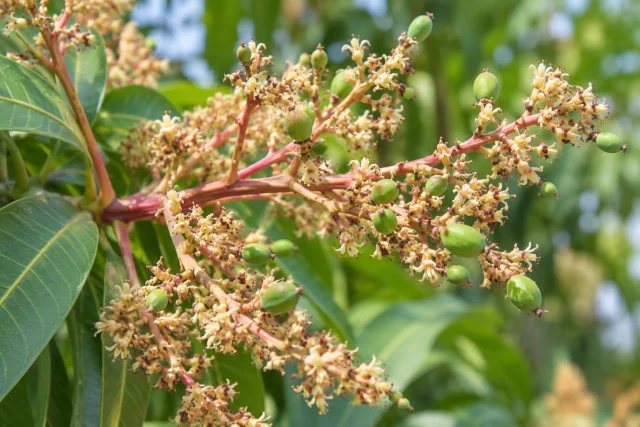
Fruit Set (generated editorial illustration)

Fruit Set

Fruit set is the transition from flowers to developing fruitlets. In mangoes, initial set is only the beginning of the crop: many small fruitlets are subsequently shed before harvest. Flower disease, weather, pollination, fertilization, and the tree's resources can all affect the process. Record when fruitlets appear and when losses occur, because a tree that never sets fruit presents a different problem from one that sets well but later drops developing mangoes.

Read more about Fruit Set

Genotype

Genotype is the genetic constitution of an organism. A mango seedling formed through fertilization has its own genetic combination, whereas a grafted scion normally preserves the genotype of its source tree. Genotype is distinct from phenotype, the characteristics actually observed under particular conditions. Poor flavor from immature fruit or weak growth in a saturated pot does not by itself demonstrate that a correctly labeled graft has changed genetically. Identity questions need provenance and, where appropriate, more specialized evidence.

Read more about Genotype

Macronutrient

A macronutrient is an essential plant nutrient required in relatively large quantities. In practical mango fertilization, the term commonly includes nitrogen, phosphorus, potassium, calcium, magnesium, and sulfur. Large requirement does not mean unlimited benefit: excess supply can create imbalance, salt injury, or growth that is poorly timed for flowering. Match a program to tree age, soil, crop stage, and local guidance, and remember that a fertilizer's three main label numbers do not describe every essential nutrient.

Read more about Macronutrient

Monoembryonic

Monoembryonic describes a seed containing one embryo. In mango, that embryo normally develops through sexual reproduction after fertilization, so its genetic makeup can differ from the mother tree even when the pollen comes from the same cultivar. A seedling therefore cannot be assumed to reproduce the named fruit from which the seed came. Use a verified grafted tree when a particular cultivar is the goal; grow seedlings for experimentation or suitable rootstocks with realistic expectations about variation.

Read more about Monoembryonic

Parthenocarpy

Parthenocarpy is fruit development without fertilization. It is a botanical process rather than a general name for all small or poorly developed fruit. Some mango fruit abnormalities involve absent or failed seed development, but outward appearance alone cannot establish exactly how they arose. Distinguish parthenocarpy from embryo abortion after fertilization and from simple growth limitation. The distinction is useful in breeding and diagnosis, while growers should avoid claiming that every seedless-looking fruit proves a tree is naturally seedless.

Read more about Parthenocarpy

Pollen Tube

A pollen tube is the structure that grows from a germinating pollen grain toward the ovule, carrying the male reproductive cells. It is part of the process between pollination and fertilization in mango flowers. Suitable pollen placement is therefore only an early step, not proof that a seed and fruit will develop. Temperature, compatibility, and flower condition can influence success. This concept helps explain why a tree can have abundant insect visits yet retain only a small share of its flowers as fruit.

Read more about Pollen Tube