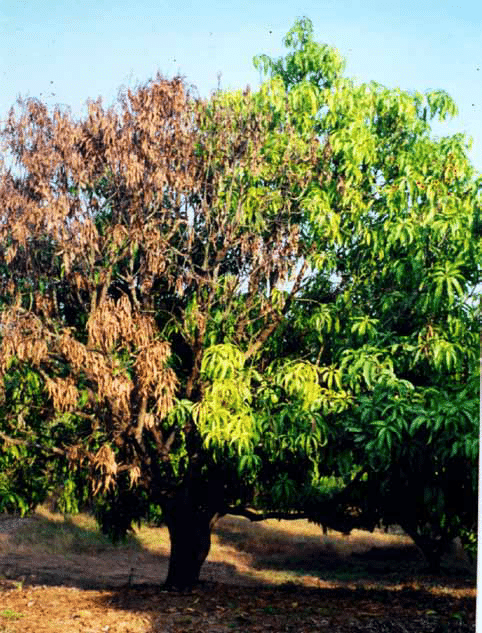
Dieback is progressive death of shoots or branches, often beginning near their tips and extending backward. On mango it can be associated with pathogens, injuries, root problems, or environmental stress, so it describes a pattern rather than one confirmed disease. Look for the boundary between living and dead wood, recent damage, and other symptoms before deciding how much to remove. Use suitable sanitation and timing when pruning, and investigate the underlying cause instead of assuming fertilizer or a generic spray will restore dead tissue.
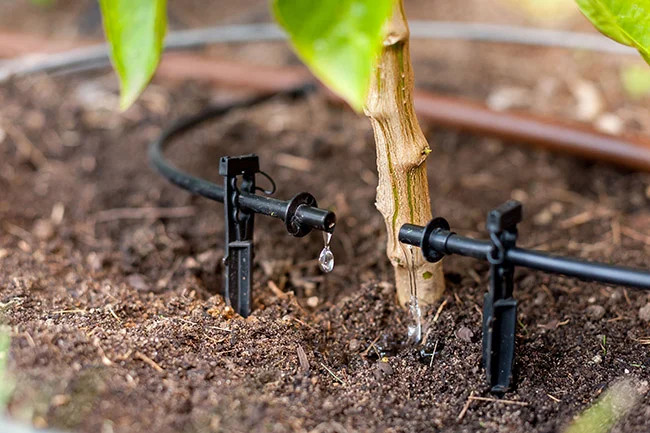
Drip irrigation delivers water slowly near the root zone through emitters or similar outlets. For mango trees it can reduce unnecessary wetting of foliage and flowers, but an efficient system still needs suitable emitter placement, working filters, and checks of soil moisture. One emitter beside the trunk may not wet enough of a larger tree's active roots. Adjust the wetted area as the tree grows and inspect for blockages or leaks rather than judging irrigation solely by how long the system runs.
Ask about mango watering
Drought tolerance is a plant's ability to withstand limited water better than a more sensitive plant under comparable conditions. An established mango may cope with dry periods more effectively than a newly planted tree, whose small root system has less access to stored soil moisture. Tolerance does not mean maximum growth or fruit production without water, nor does it make every cultivar or rootstock equally adapted. Judge irrigation needs from root-zone moisture, weather, tree age, and crop stage.
Evapotranspiration is the combined loss of water through evaporation from surfaces and transpiration from plants. Temperature, sunlight, humidity, wind, and canopy size influence it. For mango irrigation, an estimate can help explain why water demand changes between cool, cloudy periods and hot, windy weather. It is not the same as a fixed watering interval or a direct measurement of one tree's need. Combine weather information with actual root-zone moisture and the tree's developmental stage.
Fertigation is applying nutrients through an irrigation system. In a mango orchard it can deliver small, scheduled applications to the wetted root zone, but it requires suitable equipment, compatible materials, and safeguards against contamination of the water supply. Uneven irrigation produces uneven nutrient delivery, and blocked emitters can leave trees underfed or dry. Check the system and follow applicable instructions rather than treating fertigation as simply pouring any fertilizer into a water tank.
Field capacity describes the soil moisture remaining after substantial gravitational drainage has slowed. It is a useful reference for irrigation planning, not a fixed moisture percentage shared by every soil. A mango root zone can hold very different amounts of plant-available water depending on texture, structure, and rooting depth. A sensor reading is most useful when interpreted for the actual soil and placement. Do not equate field capacity with continuous saturation, which leaves much less air available to roots.
Fruit retention is the continued holding of developing fruit after initial set. A mango tree normally sheds many flowers and small fruitlets, so retention should be considered relative to stage, tree size, and normal behavior. Unusual losses can follow stress, disease, injury, or competing demands within the tree. Maintain suitable root-zone conditions and investigate the pattern rather than treating every fallen fruitlet as a nutrient deficiency or assuming a spray can preserve every fruit that initially sets.
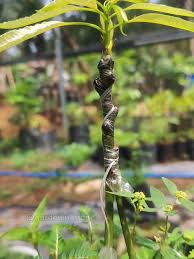
A graft is the union between a scion and a rootstock that allows them to grow as one plant. In mango, the scion supplies the named cultivar's above-ground growth, while the rootstock provides the root system and can influence vigor and adaptation. A graft is not a genetic blending of two varieties. Look for a healed, unconstricted junction when buying a tree, and remove unwanted shoots below it so rootstock growth does not replace the intended cultivar.
Graft compatibility is the ability of a scion and rootstock to form and maintain a functioning, durable union. It is different from the initial appearance of callus or bud growth: a join can begin growing yet later develop weakness or poor transport between the parts. For mango propagation, use suitable, healthy material and established combinations where information is available. Compatibility does not mean that the rootstock guarantees dwarfing, disease resistance, or cold tolerance for every scion and location.
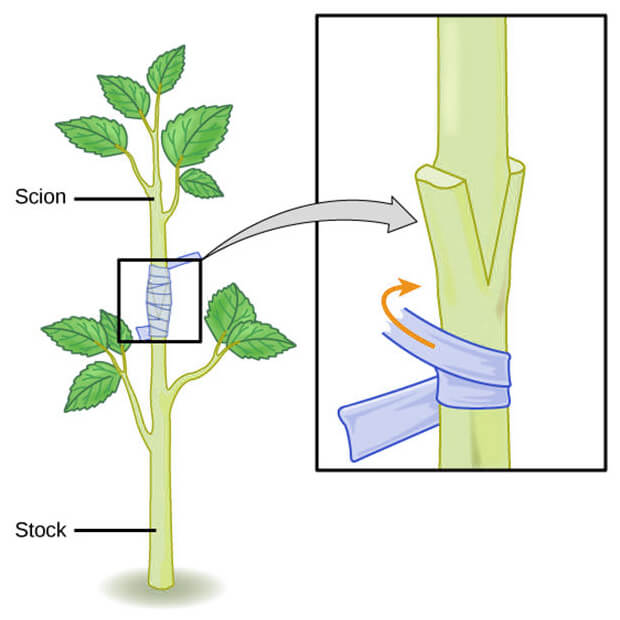
Grafting is the process of joining living plant parts so their tissues heal together. Mango growers use it to reproduce a selected cultivar on a rootstock instead of relying on genetically variable seedlings. Success depends on compatible material, close contact between cambial regions, suitable growing conditions, and protection from drying and movement. Methods include veneer, cleft, and approach grafting. The best choice depends on stem size and local practice; no method makes unhealthy or mislabeled scion wood reliable.
Read the mango grafting FAQ
Hardening off is gradually acclimating a plant to more demanding conditions after it has grown in shelter. A nursery mango moved directly from shade to strong sun, wind, and lower humidity can lose leaves or scorch even if the species normally needs full sun. Increase exposure in stages while monitoring root-ball moisture and leaf response. This is environmental adjustment, not making a tropical tree permanently cold-hardy or a substitute for protecting it from frost.
Infiltration is the entry of water through the soil surface. It differs from drainage, which includes movement through and out of the root zone after water enters. For a mango, slow infiltration can cause runoff while fast infiltration may still lead to saturation above an underground barrier. Check both surface behavior and moisture at root depth when planning irrigation. A puddle's disappearance alone does not prove that the whole planting site is adequately drained.
Interveinal chlorosis is yellowing between leaf veins while the veins remain greener. In mangoes it can suggest particular nutrient-availability problems, but leaf age, root health, and soil conditions determine how the pattern should be interpreted. Iron-related symptoms commonly appear on younger growth, while other deficiencies can affect older leaves. Use the pattern to guide investigation rather than treating it as proof from a photograph alone. A soil or leaf analysis can be more useful than repeated untargeted applications.
Leaching is movement of dissolved substances downward with water through soil or growing medium. It can carry unwanted salts out of a mango root zone, but can also waste nutrients and contaminate drainage water. Effective salt management requires suitable-quality water and a place for excess water to drain; repeatedly flooding a poorly drained pot is not successful leaching. Interpret the need from water quality, fertilizer history, and testing rather than using extra irrigation as a universal response to weak growth.
Monoembryonic describes a seed containing one embryo. In mango, that embryo normally develops through sexual reproduction after fertilization, so its genetic makeup can differ from the mother tree even when the pollen comes from the same cultivar. A seedling therefore cannot be assumed to reproduce the named fruit from which the seed came. Use a verified grafted tree when a particular cultivar is the goal; grow seedlings for experimentation or suitable rootstocks with realistic expectations about variation.
Mulch is material placed on the soil surface to moderate conditions and reduce problems such as evaporation and weed competition. Organic mulch around mango trees can support a more protected root zone as it breaks down, but it should not be heaped against the trunk. Keep inspection space around the base and avoid burying the root flare. Mulch does not repair an undrained site, replace all fertilizer, or justify watering without checking soil moisture underneath.