A mycorrhiza is an association between a fungus and plant roots in which the partners exchange resources. Such relationships can influence nutrient uptake and plant performance, but their effects depend on the fungus, host, soil, and management. The general concept does not prove that a purchased inoculant will improve every mango tree. Healthy soil conditions, suitable nutrition, and limited unnecessary root disturbance remain important. Do not treat a commercial microbial product as a substitute for correcting drainage or another clear root-zone problem.
Noob is informal internet slang for a newcomer. In mango discussions it describes a person's experience level, not a type of tree or a technical growing method. A beginner can get more useful help by describing the tree's location, age, propagation method, pot or soil conditions, and symptoms, preferably with clear photographs. The label should not discourage questions: basic checks such as drainage, light, and root-ball moisture often matter more than complicated treatments when learning to grow mangoes.
Peat moss is partly decomposed plant material accumulated in wetland peat deposits, commonly used as a moisture-retaining component of potting media. Sphagnum peat differs from the recognizable long strands sold as sphagnum moss. In a mango container it needs to be balanced with components that maintain air space; keeping a fine-textured peat mix constantly wet can stress roots. Very dry peat can be difficult to rewet, and it supplies little complete nutrition by itself.
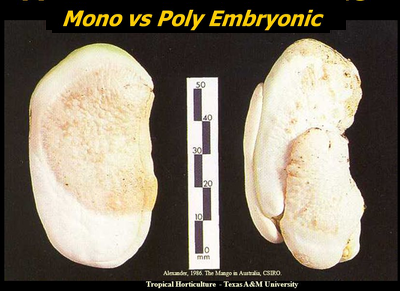
Polyembryonic describes a seed with multiple embryos. Mango seeds of this type can contain nucellar embryos derived from the mother tree's tissue as well as a sexually produced embryo; not every embryo necessarily survives or emerges. Nucellar seedlings can preserve the maternal genotype, but a sprout cannot be identified reliably as clonal merely because it is first, tallest, or strongest. This distinction matters when selecting rootstocks or attempting true-to-type seed propagation. A verified graft remains the clearest way to obtain a named cultivar.
Read the mango seed FAQ
RKN stands for root-knot nematode, a group of microscopic plant-parasitic roundworms in the genus Meloidogyne. They feed in roots and can cause swellings or galls, reducing effective root function in susceptible plants. Above-ground symptoms such as weak growth are not diagnostic because many root problems look similar. For a mango with suspect roots, use a plant-diagnostic or nematode test and obtain clean nursery material; not every soil nematode is harmful or requires treatment.
A scion is the shoot or other selected plant material joined to a rootstock during grafting. For mangoes, it carries the identity of the cultivar intended to form the upper tree and produce fruit. Scion health, maturity, freshness, and correct labeling matter as much as the cutting technique. Collect only from suitable, identified trees, protect material from drying, and do not assume that a vigorous-looking shoot is free of every transmissible problem.
SIP means sub-irrigated planter, a container that supplies water from a reservoir below the growing medium. Capillary movement carries moisture upward, but the arrangement must still provide oxygen and an overflow outlet. A mango can suffer if its root zone remains saturated, particularly during cool weather or when a small tree uses little water. Check the medium, reservoir level, drainage design, and salt accumulation rather than assuming a self-watering container prevents every watering mistake.
Soil compaction is the compression of soil into a denser condition with reduced pore space. Foot or vehicle traffic, construction, and working wet soil can contribute to it around mango trees. The result may be restricted root growth, slower infiltration, and poor aeration rather than a simple nutrient shortage. Preventing damage is often easier than correcting it beside an established tree. Avoid aggressive cultivation through major roots and assess the actual layer and extent of compaction before attempting remediation.
Soil structure is the arrangement of soil particles into aggregates and the pore spaces between them. It influences how water enters and drains, how air reaches roots, and how easily roots penetrate the ground. Mango roots can struggle in compacted soil even when the mineral texture is otherwise suitable. Protect useful structure by avoiding unnecessary traffic or digging in wet soil and managing the surface carefully. Fertilizer cannot compensate for a root zone with severely restricted air and water movement.
Soil texture describes the relative proportions of sand, silt, and clay in the mineral soil. It influences water storage, drainage, nutrient retention, and how a mango's root zone behaves after irrigation. Texture is different from structure and cannot be permanently changed by a small addition of compost. Use it to interpret moisture observations and test results, but inspect actual drainage too: a sandy surface can still overlie a compacted or poorly draining layer.
Sphagnum moss is the recognizable, long-fibered material harvested from sphagnum growth and often sold dried. It is different from the more decomposed, fine-textured material sold as peat moss, so check the actual material rather than relying only on a product name. Growers use sphagnum for moisture retention in some propagation setups, but wet moss packed too tightly can limit oxygen. It does not make mango cuttings easy to root or replace a complete, well-aerated potting medium for long-term tree growth.
SWP means self-watering planter, a general name for a container with a water reservoir or another automatic water-delivery arrangement. Many designs are also sub-irrigated planters, but the label does not guarantee suitability for a mango. Root aeration, an effective overflow, adequate container volume, and monitoring remain important. Fertilizer salts can accumulate if water repeatedly moves upward without periodic appropriate leaching. Adjust operation to the tree's water use instead of keeping the reservoir full in all seasons.
Topworking changes the cultivar carried by an established tree by grafting selected scions onto suitable branches or regrowth. On mangoes it can replace an unsatisfactory selection or create a multi-cultivar tree without starting with a new root system. The operation needs planning for branch structure, exposed bark, vigorous competing shoots, and the balance of new grafts. Large cuts and heavy canopy removal create risks, so an established tree should not be stripped indiscriminately in pursuit of a quicker crop.
Traceability is the ability to follow a product or plant material through documented stages of its history. Mango fruit records may connect an orchard block, harvest date, packing batch, and customer, while nursery records can connect a graft to its scion source and rootstock batch. Useful traceability requires labels and records that remain linked as material moves. It supports investigation and quality control but does not independently prove a cultivar claim or replace inspection for pests and disease.
Transplant shock is a temporary setback following movement or planting, often caused by disturbed roots, changed water supply, and a sudden change in exposure. A mango may wilt, drop leaves, or pause growth even when it has not acquired a new disease. Keep the original root ball appropriately moist while avoiding waterlogging and protect the tree from extreme conditions. Heavy fertilizer or drastic pruning is not an automatic cure; observe recovery and investigate persistent decline.
To up pot is to move a plant into a larger container so its roots have more room and fresh growing medium. For a mango, choose a container with effective drainage and avoid a very large jump that leaves unused medium wet for long periods. Preserve the original planting depth and handle the root ball carefully. Watering needs may change after the move, so check both the old root ball and the surrounding new mix rather than judging only the surface.