

This site contains affiliate links for which we may be compensated.

Mango Database
Mangoes in a sunlit tropical orchard

Mango Glossary

Understand the language of mango growing, one term at a time.

Explore Mango Terminology

Browse definitions and growing concepts to expand your mango knowledge.

Showing 64–70 of 91 terms

Matching Mango Varieties

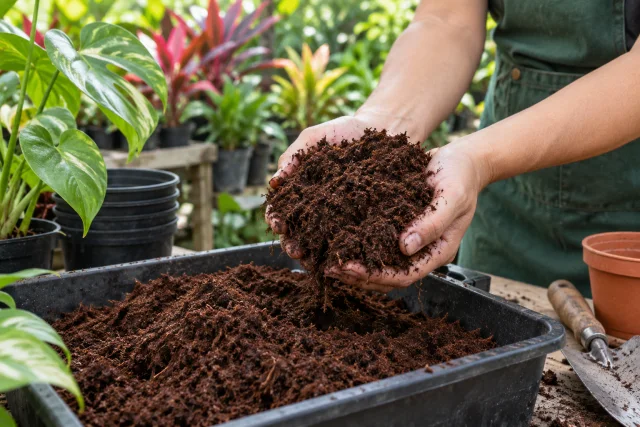
Peat Moss (generated editorial illustration)

Peat Moss

Peat moss is partly decomposed plant material accumulated in wetland peat deposits, commonly used as a moisture-retaining component of potting media. Sphagnum peat differs from the recognizable long strands sold as sphagnum moss. In a mango container it needs to be balanced with components that maintain air space; keeping a fine-textured peat mix constantly wet can stress roots. Very dry peat can be difficult to rewet, and it supplies little complete nutrition by itself.

A container medium behaves differently from the mineral soil in an orchard. Its particle sizes, decomposition, and container geometry influence how much water remains after drainage. Evaluate peat as one component of the complete mixture, and check moisture within the original root ball after repotting rather than assuming the surrounding fresh medium represents it.
Read more about Peat Moss

Pectin

Pectin is a group of complex plant-cell-wall carbohydrates important in the middle lamella and primary walls. Changes in pectin contribute to how mango flesh softens during ripening, together with other structural and biochemical changes. It is not a synonym for the visible strings around a mango stone. Understanding pectin helps separate normal texture development from the impression that all softening is water loss, while damaged or decaying flesh still needs to be assessed separately.

Pectic materials contribute to the way neighboring cells adhere and to changes in tissue texture. They are not the same as the entire cell wall or all dietary fiber. Their role in ripening is best understood alongside other changes in fruit structure rather than as a single substance that switches a mango from hard to soft.

Further reading: Research on mango postharvest ripening physiology.

Read more about Pectin

Pectinase

Pectinase is a general term for enzymes that act on pectic substances. Different enzymes alter pectin in different ways, so the term does not identify a single reaction or one universal ripening rate. Pectin-related enzyme activity contributes to changes in mango tissue texture. Commercial processing may also use enzyme preparations, but a fruit becoming softer does not establish that an external enzyme was applied. Interpret texture alongside maturity, handling, temperature history, and signs of deterioration.

Different pectin-modifying enzymes change distinct features of pectic substances, including their chemical substitutions or chain structure. Their combined activity contributes to tissue changes rather than one enzyme acting as a universal softness control. Keep a general enzyme-family term separate from a measured activity reported for a particular cultivar, treatment, or ripening stage.

Further reading: Research on mango postharvest ripening physiology.

Read more about Pectinase

Pest Scouting

Pest scouting is the systematic inspection of a planting to detect and record pests, beneficial organisms, and damage. For mango, useful records include the part inspected, number of trees or organs checked, pest life stage, severity, and date. Repeating a consistent approach makes trends easier to interpret than occasional photographs of the worst leaf. Scouting supports decisions rather than automatically triggering treatment, and unfamiliar damage may still require expert identification or laboratory assistance.

A repeatable route and sampling method make observations comparable through time. Record both how many units were examined and how many were affected. Checking only the most damaged leaf each visit cannot describe population change across the planting, while consistent samples can help distinguish an isolated problem from a developing outbreak.

Further reading: University of California IPM: Monitoring and Thresholds.

Read more about Pest Scouting

Petiole

The petiole is the stalk connecting a leaf blade to the stem. It contains vascular connections that support movement between the blade and the rest of the plant. In mango observations, distinguish damage on the petiole from damage on the blade or the twig carrying it. A photograph showing the attachment, both blade surfaces, and nearby growth is more useful for diagnosis than a detached leaf with its stalk missing.

The petiole connects a blade with a node on the stem, helping establish the leaf's orientation in a diagnostic image. Include that connection when documenting an unfamiliar symptom or growth pattern. Damage at the stalk can affect an otherwise relatively normal-looking blade, so examine the attachment as well as the conspicuous leaf surface.

Further reading: Oregon State University: Vegetative Plant Parts.

Read more about Petiole

Plumule

The plumule is the embryonic shoot, including the developing shoot tip and its first leaf structures. It grows upward as a mango seedling establishes itself, while the radicle develops below it. Root emergence alone does not mean that the shoot has failed; the two structures need not become visible at the same moment. Keep the seedling's identity and germination date on its label, and protect tender new growth from handling damage and abrupt exposure changes.

The young shoot includes developing organs that continue expanding after germination begins. Their orientation and connection to the seed are more reliable anatomical guides than color alone. Photograph emergence without pulling at the structure, and avoid interpreting a difference in the timing of visible shoot growth as proof of cultivar identity.

Further reading: World Agroforestry: Mangifera indica.

Read more about Plumule
Polyembryonic

Polyembryonic

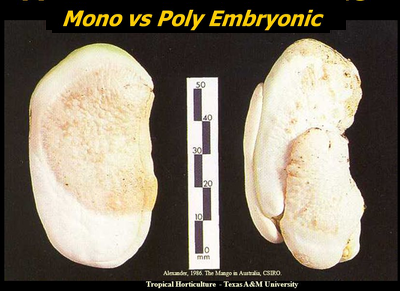
Polyembryonic describes a seed with multiple embryos. Mango seeds of this type can contain nucellar embryos derived from the mother tree's tissue as well as a sexually produced embryo; not every embryo necessarily survives or emerges. Nucellar seedlings can preserve the maternal genotype, but a sprout cannot be identified reliably as clonal merely because it is first, tallest, or strongest. This distinction matters when selecting rootstocks or attempting true-to-type seed propagation. A verified graft remains the clearest way to obtain a named cultivar.

Read the mango seed FAQ

Multiple sprouts can compete for space and resources when kept together in a small container. Their separation requires care because roots and seed tissues may be intertwined. Keep the original seed's identity with every resulting plant; neither a particular root position nor the number of leaves alone establishes which embryo produced a sprout.

Read more about Polyembryonic