

This site contains affiliate links for which we may be compensated.

Mango Database
Mangoes in a sunlit tropical orchard

Mango Glossary

Understand the language of mango growing, one term at a time.

Explore Mango Terminology

Browse definitions and growing concepts to expand your mango knowledge.

Showing 71–77 of 91 terms

Matching Mango Varieties

Powdery Mildew

Powdery mildew is a fungal disease that can produce whitish growth on susceptible mango flowers, young fruit, and other tissues. Flower infection can reduce fruit set even if the rest of the tree looks vigorous. It is different from sooty mold, which grows on insect honeydew, and should not be diagnosed solely from a distant photograph. Monitor emerging panicles, compare symptoms carefully, and seek locally appropriate guidance before using a product, especially where pollinators are visiting flowers.

A powdery appearance needs to be interpreted with the affected organ and surrounding symptoms. Deposits left by sprays or dust are different from fungal growth, and aging flowers differ from infected ones. Document fresh clusters and their development rather than assessing the entire crop from one old, heavily damaged panicle.
Read more about Powdery Mildew

Radicle

The radicle is the embryonic root that develops into the seedling's primary root during germination. Recognizing it helps growers position and handle a germinating mango seed without mistaking the emerging root for a shoot. It is delicate and should not be bent sharply or left exposed to drying air. Once root growth begins, provide a clean, well-drained growing medium and sufficient container depth rather than repeatedly lifting the seed to inspect its progress.

The first root establishes a connection with the growing medium, after which branching increases the explored volume. Physical damage at this early stage can matter even when the seed still appears sound. Prepare the container before handling a germinating mango so that the exposed root spends as little time as possible unsupported or drying.

Further reading: World Agroforestry: Mangifera indica.

Read more about Radicle

Redbanded Thrips

Redbanded thrips, Selenothrips rubrocinctus, is a thrips species that can damage mango foliage through feeding. Its immature stages have a characteristic reddish band, although confident identification requires more than a distant color impression. Feeding injury may include discoloration or bronzing, with other evidence helping distinguish it from nutrient or weather damage. Check both leaf surfaces and the insects present, and avoid assuming that every thrips species or every bronze leaf represents this particular pest.

Life-stage appearance is useful evidence, but photographs should also show the insects' size and the affected tissue. Old feeding injury can remain after a population has declined. Separate observations of active insects from residual discoloration so that a persistent bronze patch is not automatically counted as continuing damage.

Further reading: UF/IFAS: Mango Insect Pests and Beneficials.

Read more about Redbanded Thrips

Respiration

Respiration is the process by which living tissues use stored compounds and oxygen to release energy, producing carbon dioxide and water. Harvested mangoes remain alive and continue respiring as they ripen. Temperature and fruit condition influence the rate, which helps explain changes in storage life and the need for suitable handling. Slowing respiration is not the same as stopping deterioration, and enclosing fruit without adequate gas exchange can create off-flavors or injury instead of preserving quality.

The fruit continues using its own reserves after separation from the tree. Changes in temperature and gas conditions can alter that metabolism, but suppressing normal processes too strongly can injure the fruit. A storage strategy therefore balances slower deterioration with the living tissue's need for an atmosphere and temperature it can tolerate.

Read more about Respiration
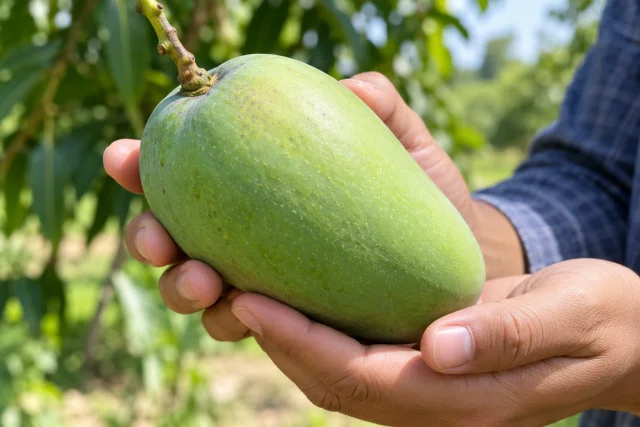
Shoulders (generated editorial illustration)

Shoulders

Shoulders are the upper curves of a mango near the stem attachment. Their fullness can be one useful sign of fruit development, particularly when compared with other fruit of the same cultivar. Raised shoulders alone do not prove that a mango is eating-ripe or ready to harvest, because natural shape varies between varieties. Combine shape with known development time, internal maturity observations where available, and the expected behavior of that tree rather than relying on a single photograph or universal rule.

Shoulder shape is best compared within a known cultivar and a sequence of developmental stages. A full shoulder on a naturally rounded fruit is not equivalent to the same outline on an elongated selection. Including the stalk attachment and an overall side view makes photographs more useful for interpreting this part of the fruit.

Read more about Shoulders

Soft Nose

Soft nose is a mango internal disorder characterized by excessive softening near the fruit's blossom end or tip, sometimes with discoloration or spongy tissue. It differs in location and appearance from ordinary uniform ripening and from decay starting at the stem end. Several factors can be involved in fruit breakdown, so an association with nutrition is not a diagnosis of one specific deficiency. Inspect cut fruit and handling history before deciding whether a crop or storage practice needs adjustment.

The blossom end is opposite the stem attachment, so orientation matters when documenting the defect. Photograph the whole cut fruit and the affected region rather than an isolated piece of soft flesh. Distinguish tissue breakdown from a localized bruise that happened to occur near the tip during picking or transport.

Read more about Soft Nose

Soil Sampling

Soil sampling collects material intended to represent a defined area and depth for laboratory testing. For mango, separate areas with different soil, irrigation, or management histories rather than mixing every location together. Follow the laboratory's instructions for depth, number of subsamples, preparation, and shipping. A sample from one unusually wet or recently fertilized spot can misrepresent the broader root zone, while a well-labeled representative sample provides a more useful basis for interpreting pH, salts, and nutrient measurements.

A representative sample combines suitable subsamples from a defined area, while a problem sample may deliberately target a contrasting patch. Label those purposes clearly. Mixing a damaged location with an otherwise uniform planting can dilute the evidence needed to diagnose the patch and make the broader sample harder to interpret.

Further reading: Penn State: Soil Sampling.

Read more about Soil Sampling