

This site contains affiliate links for which we may be compensated.

Mango Database
Mangoes in a sunlit tropical orchard

Mango Glossary

Understand the language of mango growing, one term at a time.

Explore Mango Terminology

Browse definitions and growing concepts to expand your mango knowledge.

Showing 85–91 of 91 terms

Matching Mango Varieties

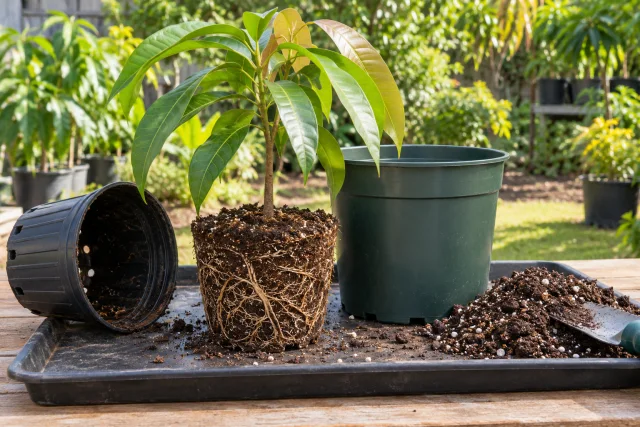
up-pot (generated editorial illustration)

up-pot

Up-pot is the hyphenated form of up pot, meaning to transplant a container-grown plant into a larger pot. Both spellings describe the same container-growing operation rather than a separate propagation technique. Mangoes need a stable container, drainage holes, and a growing medium that holds useful moisture without staying saturated. Repot in suitable growing weather where possible, protect disturbed roots from drying, and reassess irrigation while the tree establishes in the new volume.

Container size should be considered together with stability, usable depth, drainage, and the medium's condition. A larger decorative outer pot does not provide more root space if the plant remains in a cramped inner container. Record the actual growing-container dimensions when comparing the performance of potted mango trees.

Read more about up-pot

Veneer Grafting

Veneer grafting joins a prepared scion to a shallow cut along the side of a rootstock stem. It is used in mango propagation because it can provide a useful area of tissue contact without immediately removing the entire rootstock top. Accurate cuts, suitable stem maturity, and prevention of drying are important. The remaining stock growth is managed as the graft establishes. Success rates depend on material, weather, and skill rather than a method name alone.

The technique makes a relatively shallow fitting surface on the stock and a corresponding cut on the scion. The exact dimensions depend on the stems being joined. Its success is best documented by tissue condition, secure contact, and subsequent development, rather than by how closely an operation resembles a photograph of another grower's cuts.

Read more about Veneer Grafting

Volatile Organic Compounds

Volatile organic compounds are carbon-containing substances that can readily enter the gas phase under relevant conditions. In mango, mixtures of volatile compounds contribute to aroma, and their sensory importance depends on odor thresholds as well as concentration. Smelling a coconut-like or resinous note does not identify one chemical with certainty. Cultivar, ripeness, and sample handling influence the profile, so tasting notes should describe an impression without presenting an unmeasured chemical analysis as fact.

Analytical detection and sensory importance are not the same. A substance present at a low concentration may be noticeable if its odor threshold is low, while a more abundant compound may contribute less to the perceived mixture. Keep measured composition, aroma descriptions, and overall flavor preference as distinct parts of a mango evaluation.

Further reading: Mango aroma development: original research.

Read more about Volatile Organic Compounds

Water Potential

Water potential describes the energy state of water relative to a reference and helps explain the direction in which water moves. Pressure, dissolved substances, and interactions with surfaces can all contribute. For mango growers, it connects apparently different problems: a dry substrate and a salty root zone can both limit access to water. It is a scientific framework, not a direct substitute for measuring soil moisture, checking drainage, and observing the condition of the roots.

Water tends to move toward lower water potential, but the factors contributing to that potential differ between soil, cells, and the atmosphere. A soil-moisture value alone therefore cannot describe the whole pathway. Interpreting water stress benefits from considering roots, dissolved salts, transport tissues, and canopy demand together.

Further reading: Oregon State University: soil moisture monitoring.

Read more about Water Potential
Wayne Pickering

Wayne Pickering

Wayne Pickering, widely known in the mango community as The Mango Man, was a nutrition educator and fruit enthusiast whose name is associated with the Pickering mango selected by Walter Zill. The person and the cultivar are related historically but are not interchangeable subjects: claims about the tree's performance should be checked against cultivar information rather than inferred from a biography. Mango Database's tribute discusses his community connection. Personal recollections should be identified as recollections, without treating an unverified quotation or date as an established scientific fact.

Read the Mango Database tribute

Read more about Wayne Pickering
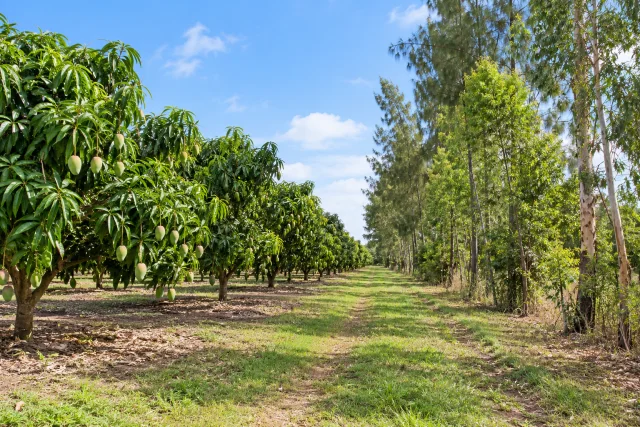
Windbreak (generated editorial illustration)

Windbreak

A windbreak is a planted or constructed barrier intended to reduce wind exposure. Near mangoes it can lessen physical stress and rubbing damage, but placement and density matter because an overly solid or close barrier can create turbulence, shade, or competition. It does not make a storm-vulnerable tree completely safe or compensate for poor branch structure. Plan for the mature size of both the mangoes and the barrier, preserving airflow and access while reducing the most damaging winds.

A windbreak changes airflow over an area rather than eliminating wind everywhere. Its height, permeability, continuity, and distance from trees influence the sheltered zone. Consider access, shading, and the growth of the barrier itself when planning it, especially where a small protective planting will eventually become a large competing canopy.

Read more about Windbreak

Xylem

Xylem is vascular tissue that conducts water and dissolved mineral nutrients through a plant and also contributes structural support. In woody mango stems, much of the wood is xylem. A successful graft must eventually establish functional vascular connections across the union, not merely remain attached externally. Disruption of water transport can produce wilting even when soil is moist, so evaluating a struggling tree requires attention to roots, trunk injuries, and the graft as well as irrigation.

Water movement through xylem is connected to water loss from the canopy and the physical continuity of the transport pathway. A break or blockage can limit supply even when soil contains water. This makes trunk condition and root function important parts of investigating wilt, rather than assuming the problem can be read from soil moisture alone.

Further reading: Washington State University: Basic Botany.

Read more about Xylem