

This site contains affiliate links for which we may be compensated.

Mango Database
Mangoes in a sunlit tropical orchard

Mango Glossary

Understand the language of mango growing, one term at a time.

Explore Mango Terminology

Browse definitions and growing concepts to expand your mango knowledge.

Showing 43–49 of 91 terms

Matching Mango Varieties

Gummosis

Gummosis

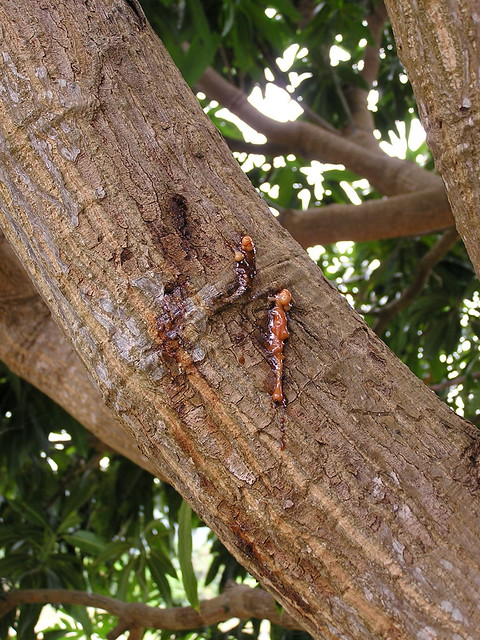
Gummosis is the exudation of gum-like material from damaged or stressed plant tissue, often visible on mango trunks or branches. It is a symptom rather than a single disease: injury, insects, infection, and environmental stress can produce similar appearances. Examine the site for wounds, boring holes, discoloration, and spreading dieback before deciding on management. Repeatedly cutting or coating the area without identifying the cause can worsen damage. A diagnostic assessment is more useful than assuming every gum deposit has the same treatment.

Exudate can conceal the margin of an injury, making a dated photograph of the surrounding bark useful. Note whether a wound followed pruning, abrasion, sun exposure, or insect activity. Repeatedly reopening the area can remove protective tissues and complicate diagnosis, so inspection should be proportionate to the tree's condition.
Read more about Gummosis
Hot Water Treatment (generated editorial illustration)

Hot Water Treatment

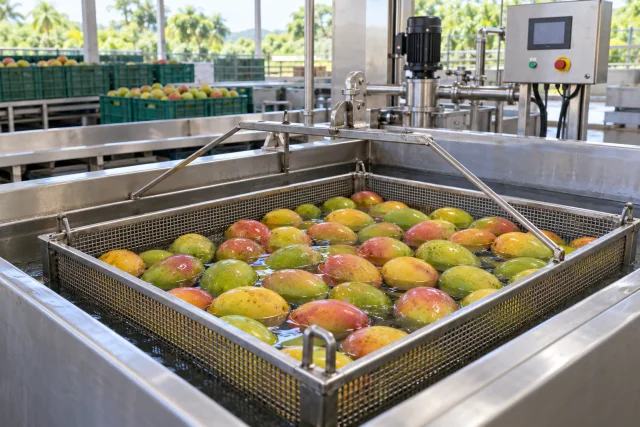
Hot water treatment is a controlled postharvest process in which mangoes are exposed to a specified water temperature for a specified time. Commercial protocols may target insect quarantine requirements or decay management, and the schedules are not interchangeable. Fruit size, maturity, equipment control, and the approved protocol affect safety and quality. Excess heat can scald fruit or disrupt ripening. It is not a general instruction to soak homegrown mangoes in hot water or a substitute for required phytosanitary certification.

Two treatments using warm water can have different purposes and validated limits. A protocol intended for a particular quarantine pest is not automatically interchangeable with a decay-control treatment. In commercial records, retain fruit size class, water-temperature measurements, exposure duration, and the applicable procedure rather than documenting only that fruit was dipped.

Read more about Hot Water Treatment

Hypocotyl

The hypocotyl is the portion of an embryonic plant axis between the cotyledon attachment and the radicle. It is a developmental region, not another name for the entire seedling trunk. Knowing its position helps interpret propagation instructions and distinguish root, seed-leaf attachment, and young shoot tissues. Mango seedlings may look different as they emerge, so identify their structures by where they connect rather than assuming that every pale or curved emerging part is a root.

The hypocotyl is identified by developmental position rather than by an arbitrary length measured from the ground. Planting depth can hide the cotyledon attachment and make a seedling photograph difficult to interpret. Include the seed and attachment region where possible when documenting early growth, while avoiding damage from repeated handling.

Further reading: World Agroforestry: Mangifera indica.

Read more about Hypocotyl
Interveinal Chlorosis (generated editorial illustration)

Interveinal Chlorosis

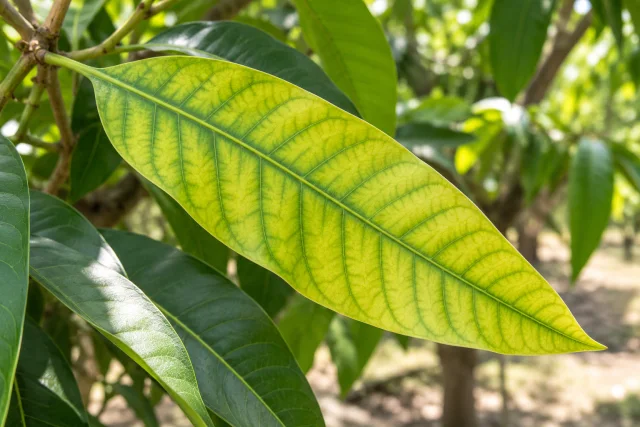
Interveinal chlorosis is yellowing between leaf veins while the veins remain greener. In mangoes it can suggest particular nutrient-availability problems, but leaf age, root health, and soil conditions determine how the pattern should be interpreted. Iron-related symptoms commonly appear on younger growth, while other deficiencies can affect older leaves. Use the pattern to guide investigation rather than treating it as proof from a photograph alone. A soil or leaf analysis can be more useful than repeated untargeted applications.

Nutrients differ in how readily a plant redistributes them between tissues, helping explain why some deficiency patterns appear first on particular leaf ages. Root damage or unsuitable chemistry can complicate that pattern. Record both young and mature foliage and supply that context with samples submitted for diagnostic analysis.

Read more about Interveinal Chlorosis

Juvenility

Juvenility is the early developmental phase during which a plant has not yet acquired the normal ability to flower. Mango seedlings can spend years in this phase, and their timing is not reliably predicted from height alone. A graft using mature cultivar material generally avoids starting the scion's development from a new seedling embryo, but the resulting tree still needs establishment. Adequate growth and suitable climate matter; applying extra fertilizer cannot guarantee that a juvenile seedling will bear immediately.

A juvenile seedling and a mature scion grafted onto a young rootstock do not have the same developmental history. The scion comes from an established selection even when the combined nursery plant is small. Distinguish chronological age, plant size, and developmental maturity when comparing how soon different mango trees begin flowering.

Read more about Juvenility

King of Fruits

King of Fruits is a cultural and promotional title often applied to mangoes to express their popularity, valued flavor, and importance in food traditions. It is not a scientific classification, legal grade, or proof that one cultivar is objectively best. The phrase may appear in festival displays, marketing, and everyday conversation. For useful growing or buying decisions, move beyond the nickname and consider maturity, flavor preference, reliable identity, and the tree's suitability for the local climate.

Read more about King of Fruits

Lamina

The lamina is the expanded blade of a leaf, distinct from the stalk that attaches it to the stem. In a mango leaf, its outline, length, width, venation, and surface condition provide useful descriptive details. Measure comparable mature leaves when documenting a tree; tender new foliage may differ substantially in size and color. Leaf shape can contribute to an identification discussion, but one lamina measurement or photograph is not enough to verify a mango cultivar.

The blade includes tissues and veins arranged around its main supporting structures. Its apparent outline changes with curling, damage, or the angle of a photograph. Lay out a sound mature leaf without stretching it, include a scale, and record both surfaces when making a botanical description of a mango tree.

Further reading: Oregon State University: Vegetative Plant Parts.

Read more about Lamina