

This site contains affiliate links for which we may be compensated.

Mango Database
Mangoes in a sunlit tropical orchard

Mango Glossary

Understand the language of mango growing, one term at a time.

Explore Mango Terminology

Browse definitions and growing concepts to expand your mango knowledge.

Showing 50–56 of 91 terms

Matching Mango Varieties

Lanceolate

Lanceolate describes a leaf or similar structure that is substantially longer than wide, broadest below the middle, and tapering toward the tip. Mango leaves are often described using this term, although individual leaves and cultivars vary. It identifies a general outline rather than a particular length or variety. When recording a leaf, combine the shape description with measurements, maturity, and clear photographs instead of using a single lance-shaped leaf to assign a cultivar name.

Shape vocabulary describes proportions and outline rather than assigning cultivar identity. Leaves on one tree can vary with age and growing conditions. Comparing several mature, undamaged leaves is more informative than selecting one unusually narrow specimen and treating its shape as representative of every shoot or fruit on the plant.

Further reading: Oregon State University: Vegetative Plant Parts.
Read more about Lanceolate

Leaf Hopper

Leaf hopper is a common name for small jumping sap-feeding insects; mango hoppers are particular members of this broader group that can feed on tender growth and flower panicles. Heavy feeding and honeydew can interfere with flowering and fruit set, but species and importance vary by region. Examine insects and fresh damage rather than assuming every small winged visitor is a pest. Pollinating flies and other useful visitors also occur on mango flowers and should not be targeted indiscriminately.

Leafhopper is a broad common name covering insects with different host associations. Adults can move rapidly when disturbed, and immature stages may have a different appearance. Preserve clear close-up photographs or a suitable diagnostic sample, together with the plant part and locality, before interpreting a sighting as a particular mango pest.

Read more about Leaf Hopper

Leaf Venation

Leaf venation is the arrangement of veins within a leaf blade. These veins contain vascular tissues and contribute to both transport and support. Mango leaves have a prominent midrib with branching lateral veins, features that can be documented in botanical photographs. Compare similarly mature leaves and include a scale when measuring them. Venation is useful supporting evidence in plant identification, but it does not reliably separate every named mango cultivar on its own.

Veins connect the blade's transport network with the petiole and stem. Their spacing and branching can be described, but leaf age and photographic scale affect comparisons. Include the midrib and margins in a clear overall view before relying on a close-up of one small region to characterize the whole leaf.

Further reading: Oregon State University: Vegetative Plant Parts.

Read more about Leaf Venation
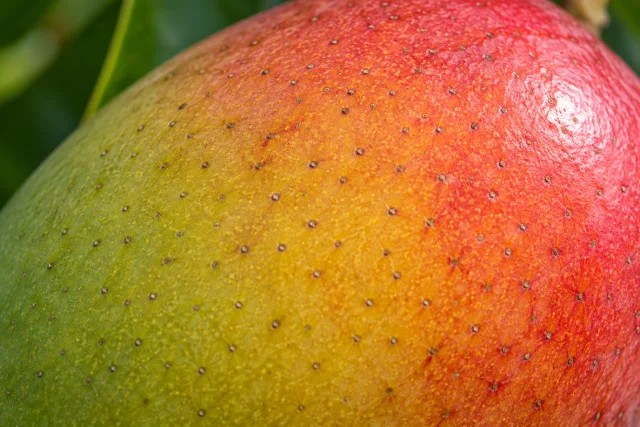
Lenticels (generated editorial illustration)

Lenticels

Lenticels are small structures in the mango peel that permit gas exchange through the fruit surface. They appear as dots whose size, color, and prominence vary with the fruit and its stage of development. Darkened lenticels can result from handling, sap exposure, storage conditions, or disease, so spotting alone does not identify a pathogen. When evaluating a mango, distinguish ordinary peel markings from expanding lesions, soft tissue, and decay rather than rejecting every visible dot.

Lenticels are not pores that a grower needs to open by polishing or scrubbing. Their pattern can be recorded with a close photograph and a wider view of the fruit. When investigating discoloration, note whether the dots changed after harvest, washing, or sap contact, and whether the underlying flesh remains sound.

Read more about Lenticels

Lesion

A lesion is a localized area of abnormal or damaged tissue. The word describes an observed feature, not a confirmed cause. Useful mango disease notes include a lesion's size, color, shape, border, depth, location, and whether it expands over time. Photograph the whole affected organ as well as the close-up. A small peel mark, an enlarging sunken fruit spot, and a dead leaf patch may all be lesions but require different explanations and responses.

Lesions can be described without deciding their cause immediately. Measurements and dated photographs establish whether an area is expanding, remaining stable, or changing as tissue ages. Include the surrounding healthy-looking region so a reviewer can distinguish a discrete spot from a broader pattern affecting veins, margins, or an entire organ.

Further reading: Purdue: Symptoms and Signs for Plant Problem Diagnosis.

Read more about Lesion

Luxury Consumption

Luxury consumption is nutrient uptake beyond the amount currently needed to support maximum growth or yield under the conditions being evaluated. Greater uptake does not necessarily deliver an additional benefit. For mango growers, it is a reminder that a higher fertilizer rate or tissue concentration is not automatically a better result. Interpret applications through tree response, appropriate testing, and environmental losses rather than trying to maximize nutrient numbers without considering balance and actual crop requirements.

The concept concerns the relationship between supply, uptake, and response. A plant may accumulate more of a nutrient while growth remains limited by another factor. Comparing applications therefore requires a defined outcome, such as growth or yield under stated conditions, rather than assuming the highest tissue concentration identifies the best nutritional program.

Further reading: USDA Agricultural Research Service: Luxury Consumption.

Read more about Luxury Consumption

Macronutrient

A macronutrient is an essential plant nutrient required in relatively large quantities. In practical mango fertilization, the term commonly includes nitrogen, phosphorus, potassium, calcium, magnesium, and sulfur. Large requirement does not mean unlimited benefit: excess supply can create imbalance, salt injury, or growth that is poorly timed for flowering. Match a program to tree age, soil, crop stage, and local guidance, and remember that a fertilizer's three main label numbers do not describe every essential nutrient.

Carbon, hydrogen, and oxygen are also essential elements required in large quantities, although routine fertilizer discussions usually focus on mineral nutrients. Their sources differ from a fertilizer bag. Adequate mineral nutrition cannot replace the light, water, air exchange, and functioning roots needed for a mango to build and maintain its tissues.

Read more about Macronutrient