

This site contains affiliate links for which we may be compensated.

Mango Database
Mangoes in a sunlit tropical orchard

Mango Glossary

Understand the language of mango growing, one term at a time.

Explore Mango Terminology

Browse definitions and growing concepts to expand your mango knowledge.

Showing 1–7 of 16 terms
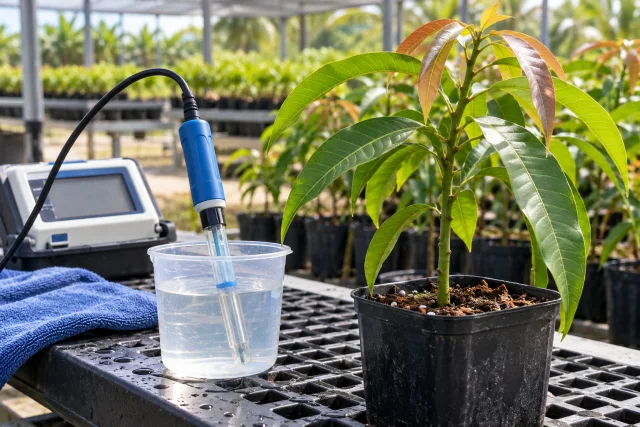
PH (generated editorial illustration)

PH

pH is a logarithmic measure of how acidic or alkaline a solution is, with 7 neutral under ordinary reference conditions. In mango growing, soil or potting-medium pH influences nutrient availability and helps explain problems such as iron deficiency in alkaline conditions. It does not measure how much fertilizer is present. Use an appropriate soil test and consider irrigation-water chemistry before adding acidifying or liming materials; changing pH blindly can create a different nutrient imbalance.

Because the scale is logarithmic, a one-unit difference represents a tenfold difference in hydrogen-ion activity, not a small linear adjustment. Soil testing uses defined extraction methods, and water pH is a separate measurement. Keep the laboratory method and sample type with results when comparing successive tests or discussing an amendment program.

Read more about PH

Phenology

Phenology is the study and recording of recurring biological stages in relation to environmental conditions. For a mango grower, useful stages include flushing, shoot rest, panicle emergence, bloom, fruit set, and harvest. A local record can show why an apparently sensible pruning or irrigation schedule produced a different result in another season. Dates alone are less informative than dates paired with weather, tree condition, and observations of the actual developmental stage.

Consistent stage descriptions make a phenology record comparable from year to year. Record the start and progression of events on identified trees rather than only the date of the most conspicuous flower cluster. Separating vegetative flushes, flowering, fruit set, and harvest helps explain why two trees harvested together may have developed differently.

Read more about Phenology

Phenotype

Phenotype is the set of observable characteristics of an organism resulting from its genotype interacting with its environment. Mango fruit size, skin appearance, growth habit, and seasonal performance are examples that can vary with growing conditions. Two trees with the same scion genotype may therefore look somewhat different in different locations. When identifying a cultivar or comparing selections, use multiple observations and reliable provenance rather than assuming one photograph or one unusual crop establishes genetic difference.

Repeated observations help distinguish a stable characteristic from environmental variation. Fruit from exposed and shaded parts of one mango tree may differ in skin appearance even while sharing a genotype. Record maturity, crop load, and growing conditions when photographing a phenotype so that the image carries enough context for later comparison.

Read more about Phenotype

Phloem

Phloem is vascular tissue that transports sugars and other organic substances between sources, such as functioning leaves, and sinks, such as growing roots or fruit. Transport follows the tree's changing demands rather than a simple rule that everything moves downward. In mango care, severe bark injury can interrupt this system even when the inner wood remains intact. Protect trunks from tight ties, machinery, and careless cuts; a visibly green canopy does not prove that an injured trunk is functioning normally.

Phloem movement serves changing sources and sinks in the plant. Different pathways can support transport in different directions, so describing it as a pipe that always carries food downward is misleading. A mango's developing shoots, roots, and fruit can have different demands as the tree moves through growth and cropping stages.

Further reading: Washington State University: Basic Botany.

Read more about Phloem

Photosynthesis

Photosynthesis uses light energy to build carbohydrates from carbon dioxide and water. Mango leaves supply these carbohydrates to support growth, maintenance, roots, flowers, and developing fruit. Removing large amounts of healthy foliage reduces the tree's light-capturing surface, although crowded or heavily shaded leaves also have limitations. Pruning decisions should balance canopy structure and light distribution with the need to retain productive foliage, rather than treating every new leaf or every shaded branch as expendable.

Light interception and carbon assimilation are related but not identical. A leaf also needs suitable water relations and functioning tissues to use available light effectively. Increasing exposure or fertilizer supply cannot compensate for every limitation, making canopy observations and root-zone assessment useful partners when investigating poor growth.

Further reading: Oregon State University: Botany Basics.

Read more about Photosynthesis

Physiological Disorder

A physiological disorder is an abnormal plant or fruit condition arising from developmental or environmental processes rather than an infectious pathogen. Mango internal breakdown, chilling injury, and some nutrient-related problems fall within this broad category. The distinction matters because a fungicide cannot correct every blemish or internal defect. Different causes can produce overlapping appearances, and damaged tissue may later decay. Examine timing, handling history, and representative fruit before assigning a cause or recommending a treatment.

Disorders can be associated with maturity, mineral balance, water relations, or temperature history, depending on the condition. Similar-looking defects may therefore need different investigations. Recording where abnormal tissue occurs in several cut fruit is more useful than assigning a single cause from the outside of one damaged mango.

Read more about Physiological Disorder

Phytosanitary Certificate

A phytosanitary certificate is an official plant-health document issued by an authorized national plant-protection organization for specified consignments and requirements. In mango trade it may relate to fruit, nursery plants, or propagation material, depending on the destination and commodity. It is not the same as an organic certificate, a nursery label, or a guarantee of flavor. Check current destination rules before shipping, because a private seller's assurance cannot replace an official document or an approved treatment requirement.

A certificate applies to a specified consignment and the conditions documented by the issuing authority. It is not a general pass that follows a cultivar name or a seller indefinitely. Keep the commodity, destination, source, and applicable documents together when planning movement, and distinguish official plant-health certification from a private statement about plant quality.

Read more about Phytosanitary Certificate