

This site contains affiliate links for which we may be compensated.

Mango Database
Mangoes in a sunlit tropical orchard

Mango Glossary

Understand the language of mango growing, one term at a time.

Explore Mango Terminology

Browse definitions and growing concepts to expand your mango knowledge.

Showing 1–5 of 5 terms
Polyembryonic

Polyembryonic

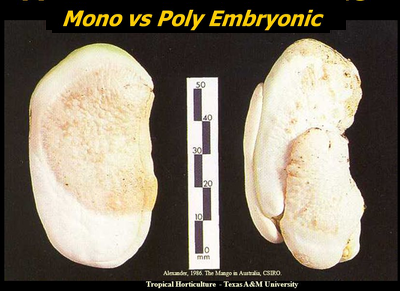
Polyembryonic describes a seed with multiple embryos. Mango seeds of this type can contain nucellar embryos derived from the mother tree's tissue as well as a sexually produced embryo; not every embryo necessarily survives or emerges. Nucellar seedlings can preserve the maternal genotype, but a sprout cannot be identified reliably as clonal merely because it is first, tallest, or strongest. This distinction matters when selecting rootstocks or attempting true-to-type seed propagation. A verified graft remains the clearest way to obtain a named cultivar.

Read the mango seed FAQ

Multiple sprouts can compete for space and resources when kept together in a small container. Their separation requires care because roots and seed tissues may be intertwined. Keep the original seed's identity with every resulting plant; neither a particular root position nor the number of leaves alone establishes which embryo produced a sprout.

Read more about Polyembryonic

Cotyledon

A cotyledon is an embryonic seed leaf. Mango embryos have two cotyledons that store reserves supporting early seedling growth before the new plant can depend on its own expanded leaves. They are not the woody stone surrounding the seed. A split or damaged cotyledon should be assessed together with the condition of the embryo, rather than treated as a reliable indicator of cultivar identity. Seedling labels should retain the parent fruit's identity without promising identical offspring.

Cotyledons are part of each embryo, so the number of emerging seedlings from a polyembryonic mango seed should not be confused with the number of cotyledons in one seedling. Keep records of seeds and resulting plants separately. Damage assessment should consider the embryo's growing regions as well as the condition of stored reserves.

Further reading: World Agroforestry: Mangifera indica.

Read more about Cotyledon

Germination Percentage

Germination percentage expresses the number of seeds that germinate under stated test conditions as a percentage of those tested. Record the observation period and what counts as germination, such as visible root emergence or development of a normal seedling. With polyembryonic mangoes, count germinating seeds separately from the number of seedlings produced. A result from a small batch describes that batch and its handling; it does not guarantee the performance of every seed from the cultivar.

If 10 of 20 tested seeds meet a defined germination criterion, the observed percentage is 50%. Counting 15 shoots from those same seeds would answer a different question when some seeds are polyembryonic. Always state the denominator and observation period so that seed germination and the number of resulting plants are not confused.

Further reading: Iowa State University: Testing Germination Rates.

Read more about Germination Percentage

Nucellar Embryony

Nucellar embryony is embryo formation from maternal nucellus tissue rather than from a fertilized egg. It explains why a polyembryonic mango seed can contain embryos genetically matching the mother tree alongside a sexually produced embryo. The term identifies the embryo's origin, whereas polyembryony describes the presence of multiple embryos. Do not select a supposed nucellar seedling solely by its size or emergence order; those visible features are not a dependable identity test for every seed.

The nucellus is maternal tissue associated with the ovule, making nucellar embryos different in origin from an embryo formed after fertilization. Multiple embryos can coexist in a mango seed. Keep that biological distinction separate from an informal grower's rule about which visible sprout must be clonal; external vigor does not reliably reveal embryo origin.

Read more about Nucellar Embryony

Zygotic Seedling

A zygotic seedling develops from an embryo formed through fertilization of an egg by pollen. It combines genetic contributions from the parents and can differ from the mother tree even after self-pollination. Mango seeds may produce such a seedling, while polyembryonic seeds can also contain nucellar embryos arising from maternal tissue. The distinction matters for breeding and identity: a seedling grown from a named mango cannot automatically be sold or recorded as that same cultivar.

Sexual reproduction combines genetic contributions rather than copying a selected branch. Even self-pollination can produce offspring that differ from the parent because genes are segregated and recombined. A useful seedling record states the known seed parent and any uncertainty about pollen origin, leaving future fruit characteristics to observation.

Read more about Zygotic Seedling