This site contains affiliate links for which we may be compensated.

Mango Database
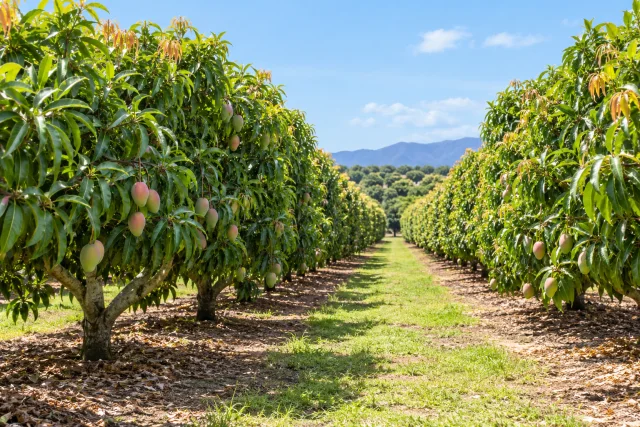
Mangoes in a sunlit tropical orchard

Mango Glossary

Understand the language of mango growing, one term at a time.

Explore Mango Terminology

Browse definitions and growing concepts to expand your mango knowledge.

Showing 64–70 of 155 terms
Haji Kalimullah Khan

Haji Kalimullah Khan

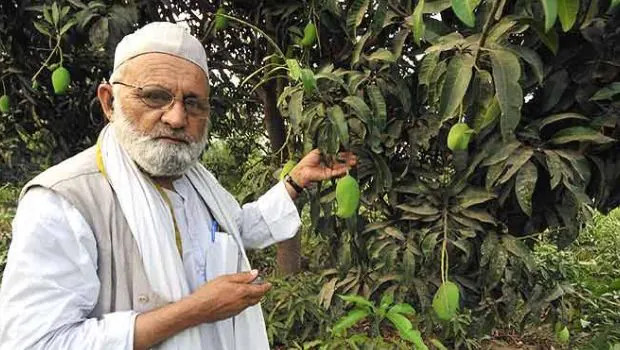
Haji Kalimullah Khan is an Indian horticulturist associated with mango growing in Malihabad, Uttar Pradesh, and widely recognized for maintaining many mango cultivars through grafting. His work illustrates the difference between placing existing cultivars on one tree and breeding a genetically new cultivar from seed. Different grafted branches retain their own identities rather than blending into a new fruit. When discussing his collection, avoid treating changing publicity counts or unusual fruit descriptions as verified botanical measurements without a documented source.
Read more about Haji Kalimullah Khan
Hardening Off (generated editorial illustration)

Hardening Off

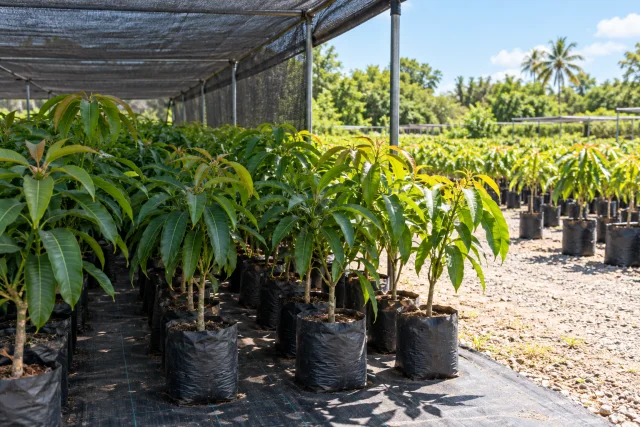
Hardening off is gradually acclimating a plant to more demanding conditions after it has grown in shelter. A nursery mango moved directly from shade to strong sun, wind, and lower humidity can lose leaves or scorch even if the species normally needs full sun. Increase exposure in stages while monitoring root-ball moisture and leaf response. This is environmental adjustment, not making a tropical tree permanently cold-hardy or a substitute for protecting it from frost.

Acclimation is most useful when it changes conditions gradually enough for observation. A mango moved from shelter into full sun may face changes in wind and drying demand as well as light. Check moisture in the original root ball during the transition, and avoid combining a major exposure change with unnecessary root disturbance.

Read more about Hardening Off
Harvest Maturity (generated editorial illustration)

Harvest Maturity

Harvest maturity is the developmental state at which fruit is suitable for picking for its intended use and market. A mango destined to ripen off the tree needs sufficient development, but it may still be firm and not ready to eat. Skin color alone is unreliable across cultivars. Combine relevant local maturity indicators with experience of the tree, and distinguish harvest maturity from eating ripeness when discussing transport, shelf life, or disappointing flavor after picking.

Picking for nearby consumption and picking for a longer distribution chain involve different handling objectives. Neither objective eliminates the need for sufficient development on the tree. Separate maturity observations made before picking from ripeness observations made after storage, so a disappointing eating result can be traced to the relevant stage.

Read more about Harvest Maturity
Hedging (generated editorial illustration)

Hedging

Hedging is cutting the sides of a tree canopy or orchard row to control spread and maintain access. In mango production it can help manage row width and light distribution, but it also removes leaves and potential bearing shoots. Timing, severity, and the response of the particular trees determine the effect on later flowering. It is different from selective structural pruning and should not be treated as a reason to shear every backyard mango into a dense wall of foliage.

A hedged surface can produce dense regrowth near the cuts while leaving interior light distribution unresolved. Assess the canopy after growth resumes rather than judging success solely from the newly trimmed outline. The operation's timing relative to harvest and shoot maturation matters when the goal includes maintaining future bearing wood.

Read more about Hedging
Honeydew (generated editorial illustration)

Honeydew

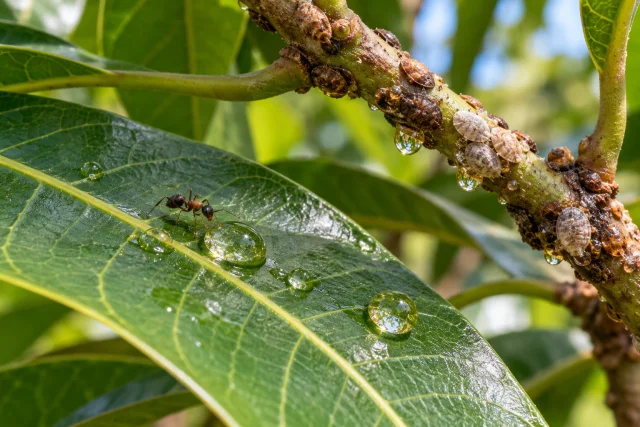
Honeydew is a sugary excretion produced by certain sap-feeding insects, including many mealybugs and soft scales. On mango leaves and fruit it can feel sticky, attract ants, and provide a surface food source for sooty mold. The mold is a consequence of the honeydew rather than proof that a fungus is attacking the leaf tissue internally. Trace the deposit to the insects producing it, and consider ant activity and natural enemies instead of repeatedly washing the surface without addressing the cause.

Sticky deposits can accumulate beneath an infestation, so the insects producing them may be on leaves or branches above the obvious mess. Inspect the surrounding canopy rather than only the coated fruit. Ant attendance and fresh honeydew can provide useful context, but neither substitutes for identifying the sap-feeding insects involved.

Read more about Honeydew

Hypocotyl

The hypocotyl is the portion of an embryonic plant axis between the cotyledon attachment and the radicle. It is a developmental region, not another name for the entire seedling trunk. Knowing its position helps interpret propagation instructions and distinguish root, seed-leaf attachment, and young shoot tissues. Mango seedlings may look different as they emerge, so identify their structures by where they connect rather than assuming that every pale or curved emerging part is a root.

The hypocotyl is identified by developmental position rather than by an arbitrary length measured from the ground. Planting depth can hide the cotyledon attachment and make a seedling photograph difficult to interpret. Include the seed and attachment region where possible when documenting early growth, while avoiding damage from repeated handling.

Further reading: World Agroforestry: Mangifera indica.

Read more about Hypocotyl

Immobilization

Immobilization incorporates inorganic nutrients into living microbial biomass or other organic forms, temporarily reducing their immediate availability to plants. During decomposition, microbes may use soil nitrogen to process residues that contain relatively little nitrogen. This is different from nutrients being permanently destroyed. In mango care, distinguish surface mulch management from mixing large amounts of fresh, high-carbon material through the root zone, and interpret a growth change using both the material's placement and the wider nutritional conditions.

Immobilization and mineralization can occur in the same soil at the same time in different materials and locations. Their balance changes as residues decompose and conditions shift. A fresh wood-rich amendment mixed into soil presents a different situation from an older surface mulch, so placement and decomposition stage should accompany descriptions of a response.

Further reading: University of Missouri: Mineralization and Immobilization.

Read more about Immobilization