

This site contains affiliate links for which we may be compensated.

Mango Database
Mangoes in a sunlit tropical orchard

Mango Glossary

Understand the language of mango growing, one term at a time.

Explore Mango Terminology

Browse definitions and growing concepts to expand your mango knowledge.

Showing 1–7 of 155 terms

FT

FT means For Trade: an item is being offered in exchange for something else rather than simply listed for a cash sale. Mango growers may trade scions, grafted plants, or seeds, but the parties need to agree on cultivar identity, quantity, condition, and timing. Plant-health and movement restrictions still apply to a trade. Keep labels attached and document the source, because a mistaken scion label can propagate an identification error through many later trees.
Read more about FT

Approach Grafting

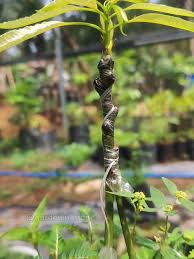
Approach grafting joins two plants while each still has its own root system during the early healing period. After a secure connection forms, the unwanted parts are removed in stages to leave the intended scion on the chosen rootstock. This can reduce immediate scion dehydration in mango propagation, but it requires positioning and supporting both plants carefully. The joined stems still need close tissue contact and enough time to heal before either plant is separated.

Keeping both partners attached to their own roots during early union development changes the moisture risk compared with using a detached scion. Separation is a later step, after sufficient connection has formed. Labels should distinguish the temporary two-root arrangement from the intended finished tree and identify which partner will supply the permanent root system.

Read more about Approach Grafting

Cleft Grafting

Cleft grafting inserts a wedge-shaped scion into a split at the cut end of a stock or branch. In mango work, matching the living cambial regions along at least one suitable edge is more important than placing a thin scion exactly in the middle of a thick stock. Secure the join and protect exposed surfaces from drying and water entry. A successful technique on one stem size or season should not be treated as a guarantee for every tree.

A cleft provides a place to seat a prepared scion, but the split alone does not establish cambial contact. Positioning must account for the thickness of bark and wood on both pieces. Protect the completed work from movement and drying, then assess the emerging shoot and union before relaxing support.

Read more about Cleft Grafting

Epicotyl Grafting

Epicotyl grafting uses the young stem above the seed leaves of a newly germinated seedling as the grafting stock. It is also called stone grafting in mango nursery practice. The tender stock and attached seed reserves make handling and timing important, and performance depends on local growing conditions and suitable scion material. It is a nursery propagation technique, not a reason to graft onto a damaged sprout or assume every seedling is immediately ready for the procedure.

The name refers to the young seedling region used in the operation, not to a new genetic type of mango. Seedling vigor and handling condition can vary even within a recently germinated batch. A useful propagation record includes the seedling's developmental stage, scion source, and survival after establishment, rather than reporting germination age alone.

Read more about Epicotyl Grafting
Graft

Graft

A graft is the union between a scion and a rootstock that allows them to grow as one plant. In mango, the scion supplies the named cultivar's above-ground growth, while the rootstock provides the root system and can influence vigor and adaptation. A graft is not a genetic blending of two varieties. Look for a healed, unconstricted junction when buying a tree, and remove unwanted shoots below it so rootstock growth does not replace the intended cultivar.

The scion and rootstock retain their own genetic identities even after vascular continuity develops. Consequently, a branch arising from below the union may produce different foliage and fruit from a branch above it. Recording the union's position makes later pruning, sucker removal, and investigation of unexpected fruit much easier.

Read more about Graft

Graft Compatibility

Graft compatibility is the ability of a scion and rootstock to form and maintain a functioning, durable union. It is different from the initial appearance of callus or bud growth: a join can begin growing yet later develop weakness or poor transport between the parts. For mango propagation, use suitable, healthy material and established combinations where information is available. Compatibility does not mean that the rootstock guarantees dwarfing, disease resistance, or cold tolerance for every scion and location.

Initial survival and long-term compatibility are not identical. Problems may emerge after a union has supported early growth, so performance records should include later vigor and union condition. A failure in one attempt can also result from technique, material condition, or aftercare rather than establishing that the combination is biologically incompatible.

Read more about Graft Compatibility

Graft Take

Graft take describes the successful initial establishment of a graft. Growers may assess it through sustained bud growth, tissue condition, and eventual union development, rather than by a scion's temporary greenness alone. A mango graft can begin growing and still fail later through drying, breakage, disease, or incompatibility. Record the date, method, rootstock, and scion source so that success rates represent comparable operations, and continue appropriate aftercare after the first buds open.

A useful success record states when the assessment was made. Early bud movement, sustained shoot growth, and survival through later establishment are different endpoints. Keeping them separate helps compare grafting attempts honestly and avoids calling an operation successful solely because its scion remained green for a short interval.

Further reading: University of Minnesota: Grafts and Wounds.

Read more about Graft Take