

This site contains affiliate links for which we may be compensated.

Mango Database
Mangoes in a sunlit tropical orchard

Mango Glossary

Understand the language of mango growing, one term at a time.

Explore Mango Terminology

Browse definitions and growing concepts to expand your mango knowledge.

Showing 71–77 of 155 terms
Infiltration (generated editorial illustration)

Infiltration

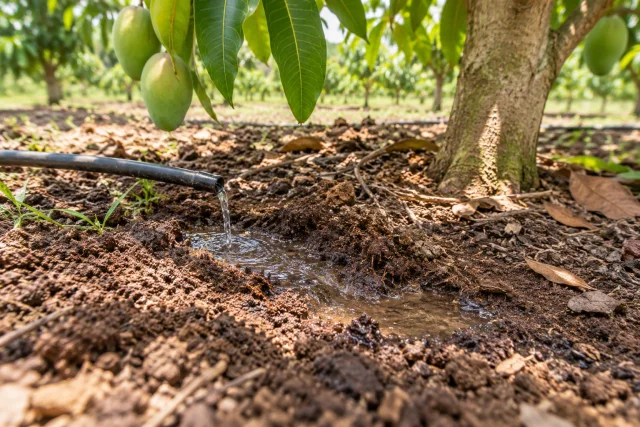
Infiltration is the entry of water through the soil surface. It differs from drainage, which includes movement through and out of the root zone after water enters. For a mango, slow infiltration can cause runoff while fast infiltration may still lead to saturation above an underground barrier. Check both surface behavior and moisture at root depth when planning irrigation. A puddle's disappearance alone does not prove that the whole planting site is adequately drained.

Infiltration is measured at the surface, but irrigation also depends on what happens after entry. Water may spread sideways above a restrictive layer or move beyond shallow roots. Observe moisture at several depths and positions so that a fast surface intake is not mistaken for uniform wetting of the whole root zone.
Read more about Infiltration
Integrated Pest Management (generated editorial illustration)

Integrated Pest Management

Integrated pest management, or IPM, combines identification, monitoring, prevention, and appropriately selected controls rather than relying on a routine spray schedule. For mangoes it means considering crop stage, actual damage, natural enemies, sanitation, and growing conditions before intervening. Chemical tools may have a role when justified and legally appropriate, but they are not the definition of the system. Record what was observed and the result of each action so future decisions are based on evidence rather than habit.

Monitoring provides a basis for deciding whether a problem is increasing and whether intervention is justified. Define the observation method and management objective first, then compare the result after an action. A system based on records can retain effective practices while avoiding repeated treatments that did not address the diagnosed cause.

Read more about Integrated Pest Management

Irrigation Scheduling

Irrigation scheduling determines when to irrigate and how much water to apply. It combines soil or substrate conditions, rooting depth, weather, tree development, and the irrigation system's output. Mango water needs change with tree size, location, and season, so a single calendar schedule is rarely suitable everywhere. Check that water reaches the root ball and surrounding roots without prolonged saturation, and adjust after rainfall or changes in canopy size instead of adding water automatically.

The amount delivered is the actual application rate multiplied by operating time, adjusted for the system's arrangement and losses. Frequency and duration solve different parts of the problem. Checking moisture after irrigation helps determine whether water reached useful depth, remained localized, or passed beyond the portion of soil the tree actively explores.

Further reading: University of Minnesota: Irrigation Management Strategies.

Read more about Irrigation Scheduling

Jelly Seed

Jelly seed is an internal mango disorder in which flesh near the seed becomes unusually soft or jelly-like. The outer fruit may not reveal the full extent until it is cut. It is distinct from normal even softening at eating ripeness and should not automatically be diagnosed as insect damage. Cultivar susceptibility, maturity, and growing conditions can influence internal breakdown, but one affected fruit does not prove a single nutrient deficiency or justify a universal fertilizer remedy.

Cutting representative fruit at a comparable stage helps document the distribution of unusually soft tissue around the stone. Include sound fruit from the same batch for comparison. The name identifies a pattern of internal breakdown; it should not be converted directly into a claim that every affected tree needs the same nutrient treatment.

Read more about Jelly Seed

Juvenility

Juvenility is the early developmental phase during which a plant has not yet acquired the normal ability to flower. Mango seedlings can spend years in this phase, and their timing is not reliably predicted from height alone. A graft using mature cultivar material generally avoids starting the scion's development from a new seedling embryo, but the resulting tree still needs establishment. Adequate growth and suitable climate matter; applying extra fertilizer cannot guarantee that a juvenile seedling will bear immediately.

A juvenile seedling and a mature scion grafted onto a young rootstock do not have the same developmental history. The scion comes from an established selection even when the combined nursery plant is small. Distinguish chronological age, plant size, and developmental maturity when comparing how soon different mango trees begin flowering.

Read more about Juvenility

King of Fruits

King of Fruits is a cultural and promotional title often applied to mangoes to express their popularity, valued flavor, and importance in food traditions. It is not a scientific classification, legal grade, or proof that one cultivar is objectively best. The phrase may appear in festival displays, marketing, and everyday conversation. For useful growing or buying decisions, move beyond the nickname and consider maturity, flavor preference, reliable identity, and the tree's suitability for the local climate.

Read more about King of Fruits

Lanceolate

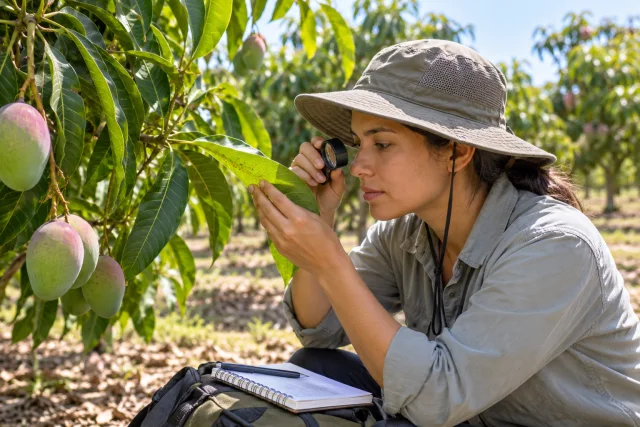
Lanceolate describes a leaf or similar structure that is substantially longer than wide, broadest below the middle, and tapering toward the tip. Mango leaves are often described using this term, although individual leaves and cultivars vary. It identifies a general outline rather than a particular length or variety. When recording a leaf, combine the shape description with measurements, maturity, and clear photographs instead of using a single lance-shaped leaf to assign a cultivar name.

Shape vocabulary describes proportions and outline rather than assigning cultivar identity. Leaves on one tree can vary with age and growing conditions. Comparing several mature, undamaged leaves is more informative than selecting one unusually narrow specimen and treating its shape as representative of every shoot or fruit on the plant.

Further reading: Oregon State University: Vegetative Plant Parts.

Read more about Lanceolate