

This site contains affiliate links for which we may be compensated.

Mango Database
Mangoes in a sunlit tropical orchard

Mango Glossary

Understand the language of mango growing, one term at a time.

Explore Mango Terminology

Browse definitions and growing concepts to expand your mango knowledge.

Showing 99–105 of 155 terms
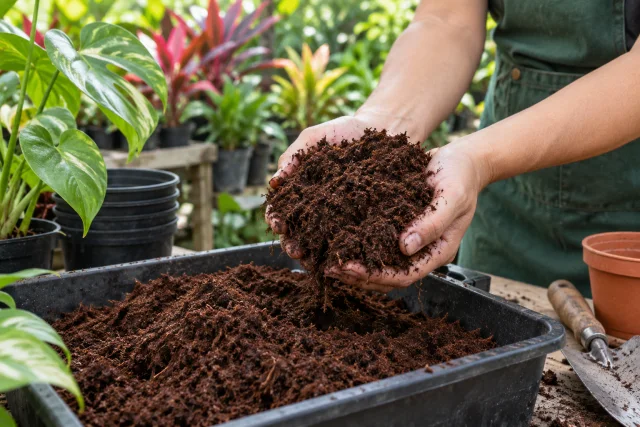
Peat Moss (generated editorial illustration)

Peat Moss

Peat moss is partly decomposed plant material accumulated in wetland peat deposits, commonly used as a moisture-retaining component of potting media. Sphagnum peat differs from the recognizable long strands sold as sphagnum moss. In a mango container it needs to be balanced with components that maintain air space; keeping a fine-textured peat mix constantly wet can stress roots. Very dry peat can be difficult to rewet, and it supplies little complete nutrition by itself.

A container medium behaves differently from the mineral soil in an orchard. Its particle sizes, decomposition, and container geometry influence how much water remains after drainage. Evaluate peat as one component of the complete mixture, and check moisture within the original root ball after repotting rather than assuming the surrounding fresh medium represents it.
Read more about Peat Moss

Pectin

Pectin is a group of complex plant-cell-wall carbohydrates important in the middle lamella and primary walls. Changes in pectin contribute to how mango flesh softens during ripening, together with other structural and biochemical changes. It is not a synonym for the visible strings around a mango stone. Understanding pectin helps separate normal texture development from the impression that all softening is water loss, while damaged or decaying flesh still needs to be assessed separately.

Pectic materials contribute to the way neighboring cells adhere and to changes in tissue texture. They are not the same as the entire cell wall or all dietary fiber. Their role in ripening is best understood alongside other changes in fruit structure rather than as a single substance that switches a mango from hard to soft.

Further reading: Research on mango postharvest ripening physiology.

Read more about Pectin

Pectinase

Pectinase is a general term for enzymes that act on pectic substances. Different enzymes alter pectin in different ways, so the term does not identify a single reaction or one universal ripening rate. Pectin-related enzyme activity contributes to changes in mango tissue texture. Commercial processing may also use enzyme preparations, but a fruit becoming softer does not establish that an external enzyme was applied. Interpret texture alongside maturity, handling, temperature history, and signs of deterioration.

Different pectin-modifying enzymes change distinct features of pectic substances, including their chemical substitutions or chain structure. Their combined activity contributes to tissue changes rather than one enzyme acting as a universal softness control. Keep a general enzyme-family term separate from a measured activity reported for a particular cultivar, treatment, or ripening stage.

Further reading: Research on mango postharvest ripening physiology.

Read more about Pectinase
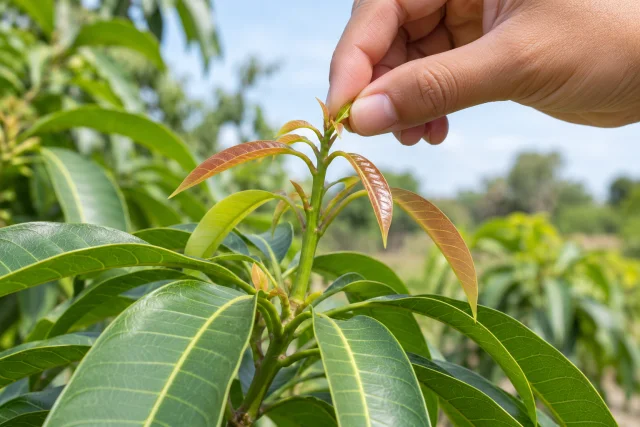
Pinch (generated editorial illustration)

Pinch

To pinch is to remove the soft growing tip of a shoot, usually with fingers or a small clean tool. On a young mango, this can reduce apical dominance and encourage side branches, helping form a manageable framework. Timing matters: repeated tip removal delays shoot maturity and can remove future flowering sites. Pinching is a small training cut, not a substitute for structural pruning, and should be avoided when a weak or newly stressed tree needs foliage to recover.

The growth response depends on the buds left below the removed tip. Observe their position before cutting, and later select branches with useful spacing rather than retaining every new shoot. On a young tree, small, deliberate training steps are easier to evaluate than repeated removal of all terminal growth without a clear structural objective.

Read more about Pinch

Planting Basin

A planting basin is a shallow soil arrangement intended to hold irrigation near a newly planted tree while water infiltrates. Its usefulness depends on drainage, rainfall, slope, and how water reaches the root ball. For mango, a basin should not become a permanently waterlogged depression or keep the trunk base buried. Inspect where water actually collects after irrigation and reshape the basin as roots establish, rather than leaving an installation feature unchanged indefinitely.

The basin's shape influences where water collects, not just how tidy the planting looks. Inspect it after an actual irrigation event and after heavy rain. As the mango establishes, the useful wetted area needs to expand with the root system rather than remaining permanently concentrated in a small ring beside the trunk.

Further reading: UF/IFAS: Mango Growing in the Florida Home Landscape.

Read more about Planting Basin

Plashing

Plashing is an older term associated with interlacing or laying branches in hedge work and is sometimes used alongside pleaching. It does not describe a separate mango propagation method. Interwoven mango branches can rub, shade one another, or create difficult picking conditions, so the technique should not be confused with deliberate grafting. A grower wanting several cultivars on one tree needs compatible grafts and balanced branch management rather than merely weaving different trees together.

Historical descriptions may use the word for hedge-laying operations that involve bending or partially cutting stems. That context is important when interpreting an old gardening text. A technique designed to maintain a stock-proof hedge should not be transferred directly to a fruiting mango tree, where branch integrity and healthy bearing wood have different priorities.

Read more about Plashing
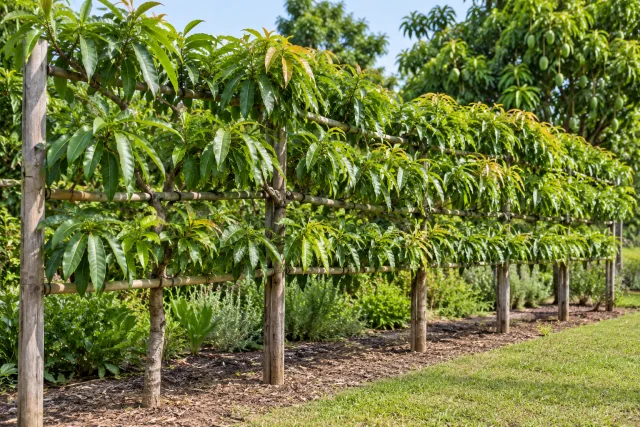
Pleaching (generated editorial illustration)

Pleaching

Pleaching is training and interweaving branches to form a screen or other living structure. Adjacent branches may eventually join where tissues make suitable contact, but simple interweaving does not guarantee a functional graft. Mangoes are generally trained for light, access, airflow, and safe branch structure rather than as dense pleached barriers. Treat references to this technique as a landscape-training concept, not a recommended way to combine cultivars or a substitute for a properly made graft.

A trained living screen requires ongoing attention as branches thicken and extend. Crossed stems can develop pressure points long before they form any lasting connection. In a fruit-growing setting, access for inspection and harvest should be considered from the beginning; an attractive interwoven pattern is not necessarily a productive orchard framework.

Read more about Pleaching