This site contains affiliate links for which we may be compensated.

Mango Database
Mangoes in a sunlit tropical orchard

Mango Glossary

Understand the language of mango growing, one term at a time.

Explore Mango Terminology

Browse definitions and growing concepts to expand your mango knowledge.

Showing 106–112 of 155 terms

Plumule

The plumule is the embryonic shoot, including the developing shoot tip and its first leaf structures. It grows upward as a mango seedling establishes itself, while the radicle develops below it. Root emergence alone does not mean that the shoot has failed; the two structures need not become visible at the same moment. Keep the seedling's identity and germination date on its label, and protect tender new growth from handling damage and abrupt exposure changes.

The young shoot includes developing organs that continue expanding after germination begins. Their orientation and connection to the seed are more reliable anatomical guides than color alone. Photograph emergence without pulling at the structure, and avoid interpreting a difference in the timing of visible shoot growth as proof of cultivar identity.

Further reading: World Agroforestry: Mangifera indica.
Read more about Plumule

Pollination

Pollination is the transfer of pollen to a flower's receptive stigma. Mango panicles bear male flowers and bisexual flowers, and insects such as flies and bees can help move pollen between them. A mango can often set fruit without a second cultivar, but pollination is only one step: fertilization, weather, disease, and the tree's resources also influence retention. Protect useful flower visitors and avoid interpreting every fallen flower as evidence that the tree needs a pollination partner.

Pollen transfer is followed by additional biological steps before a flower can become a fruit. Pollen must reach a receptive stigma and complete the processes leading to fertilization. Observing flower visitors is useful, but visitor numbers alone cannot establish successful fruit set; flower condition and subsequent fruitlet development provide separate evidence.

Read more about Pollination
Polyembryonic

Polyembryonic

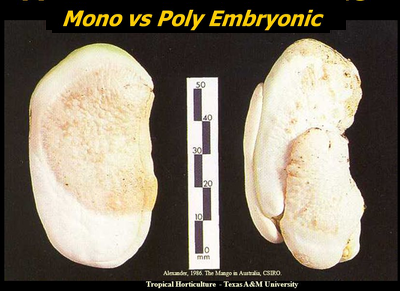
Polyembryonic describes a seed with multiple embryos. Mango seeds of this type can contain nucellar embryos derived from the mother tree's tissue as well as a sexually produced embryo; not every embryo necessarily survives or emerges. Nucellar seedlings can preserve the maternal genotype, but a sprout cannot be identified reliably as clonal merely because it is first, tallest, or strongest. This distinction matters when selecting rootstocks or attempting true-to-type seed propagation. A verified graft remains the clearest way to obtain a named cultivar.

Read the mango seed FAQ

Multiple sprouts can compete for space and resources when kept together in a small container. Their separation requires care because roots and seed tissues may be intertwined. Keep the original seed's identity with every resulting plant; neither a particular root position nor the number of leaves alone establishes which embryo produced a sprout.

Read more about Polyembryonic
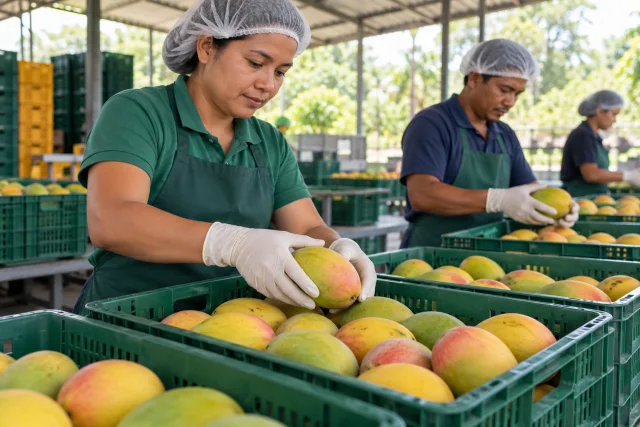
Post-Harvest Handling (generated editorial illustration)

Post-Harvest Handling

Post-harvest handling covers the steps between picking fruit and its final use, including moving, sorting, cleaning, packing, ripening, and storage. Mangoes can suffer sap burn, bruising, temperature injury, and decay during this period even when they looked sound on the tree. Gentle handling, clean equipment, and conditions suited to maturity help preserve quality. Trace the whole sequence when investigating losses rather than assuming every defect began in the orchard or can be corrected by a later treatment.

Small injuries accumulate across picking, transport, sorting, and packing. A mango that leaves the tree sound may arrive bruised if repeatedly dropped or compressed. Trace a batch through each handling stage when investigating losses, and separate the effects of initial harvest maturity from damage introduced after picking.

Read more about Post-Harvest Handling

Powdery Mildew

Powdery mildew is a fungal disease that can produce whitish growth on susceptible mango flowers, young fruit, and other tissues. Flower infection can reduce fruit set even if the rest of the tree looks vigorous. It is different from sooty mold, which grows on insect honeydew, and should not be diagnosed solely from a distant photograph. Monitor emerging panicles, compare symptoms carefully, and seek locally appropriate guidance before using a product, especially where pollinators are visiting flowers.

A powdery appearance needs to be interpreted with the affected organ and surrounding symptoms. Deposits left by sprays or dust are different from fungal growth, and aging flowers differ from infected ones. Document fresh clusters and their development rather than assessing the entire crop from one old, heavily damaged panicle.

Read more about Powdery Mildew

Pre-rooting

Pre-rooting means encouraging roots to begin developing before a cutting is moved to its intended growing container or site. The term occurs in hobby propagation discussions, but mango cuttings are generally less dependable than seedling rootstocks followed by grafting. A swollen bud or fresh leaves do not prove that a cutting has rooted; stored reserves can support temporary growth. Maintain suitable moisture and aeration, avoid claiming guaranteed success, and distinguish this method from germinating a mango seed.

Root initiation and successful establishment are separate milestones. A propagation record should identify the source shoot, medium, moisture conditions, and evidence of roots before potting. If a cutting produces a brief flush and then collapses, the first leaves may have been supported by stored reserves rather than a durable supply from newly formed roots.

Read more about Pre-rooting

Precocity

Precocity is a tendency to reach reproductive activity relatively early. In mango descriptions it may refer to a cultivar or a grafted tree that flowers and fruits at a young age under suitable conditions. It is a comparative trait, not a promise of a crop in a fixed year after purchase. A very young tree carrying fruit can also sacrifice establishment and branch development, so early flowering should be evaluated alongside tree strength rather than treated as the only sign of quality.

Early fruiting should be evaluated alongside the tree's ability to support a crop and maintain growth. A flower or a single retained mango on a small nursery tree does not establish its future productivity. Compare plants with similar propagation histories and growing conditions before treating an unusually early crop as a stable cultivar characteristic.

Read more about Precocity