This site contains affiliate links for which we may be compensated.

Mango Database
Mangoes in a sunlit tropical orchard

Mango Glossary

Understand the language of mango growing, one term at a time.

Explore Mango Terminology

Browse definitions and growing concepts to expand your mango knowledge.

Showing 8–14 of 14 terms
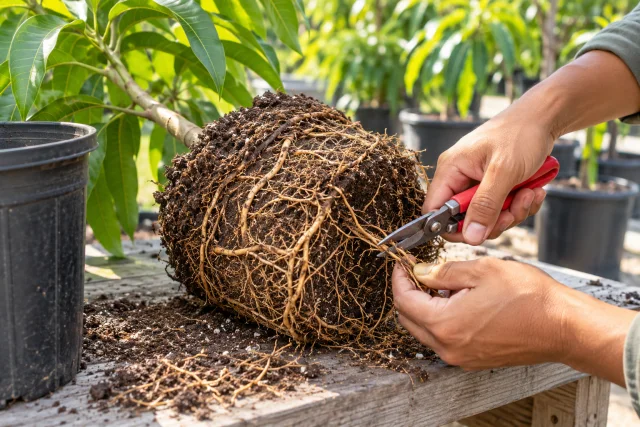
Root Bound (generated editorial illustration)

Root Bound

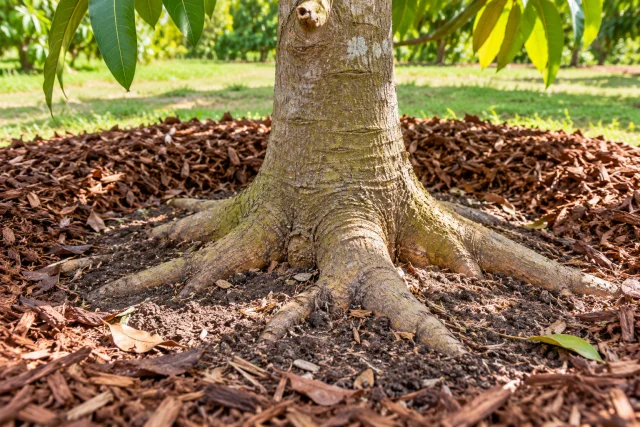
Root bound describes a container plant whose roots have become crowded, often circling the pot or forming a dense outer mass. A tall mango in a small container may have this problem even when its leaves look healthy. Root arrangement can affect later establishment and stability, so inspect nursery stock before buying. Repotting is not just placing the intact dense mass in more wet medium; handling decisions should account for root condition without causing unnecessary damage to a sensitive young tree.

Roots may circle along the container wall, turn downward, or form other constrained patterns. These conditions cannot be assessed from canopy height alone. Compare the root ball and the tree's development when planning repotting, and distinguish a dense mass of healthy roots from damaged, decaying, or poorly distributed roots requiring a different response.
Read more about Root Bound
Root Flare (generated editorial illustration)

Root Flare

The root flare is the transition near the base of a tree where the trunk broadens into major roots. Recognizing it helps avoid planting a mango too deeply or piling mulch against the trunk. Nursery media can hide the original position, so inspect the tree rather than assuming the top of the pot always marks the correct ground level. A visible graft union is a different feature, usually higher on the stem, and should not be mistaken for the root flare.

Planting depth should be evaluated relative to the tree's anatomy rather than the container rim. Soil or mulch can accumulate over the flare after planting, and an existing nursery surface may already hide it. Keep the base inspectable, and avoid confusing a swelling at the graft junction with the transition into structural roots.

Read more about Root Flare
Root Pruning (generated editorial illustration)

Root Pruning

Root pruning is the deliberate cutting of roots to alter a plant's root system or fit it into a managed container. For mango, it can also create significant stress, reduce water uptake, and compromise stability if structural roots are damaged. It should not be presented as a routine or universally safe method of forcing flowering. Container work requires particular care with timing and aftercare; cutting roots of a large landscape tree warrants specialist advice rather than experimentation near the trunk.

Root pruning changes both the absorbing surface and the balance between roots and foliage. The response depends on how much tissue is removed, the type of roots affected, and conditions during recovery. In containers, inspect the actual root pattern before choosing a technique instead of cutting a fixed fraction from every mango root ball.

Read more about Root Pruning

Root-Zone Hypoxia

Root-zone hypoxia means that oxygen availability around roots is too low for normal functioning. It often accompanies prolonged saturation because water-filled pores restrict gas exchange. Mango roots can therefore struggle in wet soil even though water is abundant, and wilting does not always mean irrigation is needed. Examine drainage, compaction, container outlets, and the duration of saturation. Improving oxygen conditions requires addressing the root environment rather than treating foliage alone or adding fertilizer to stressed roots.

The duration of low oxygen matters as much as the presence of water at one moment. Warm, actively growing roots still need a suitable supply for respiration. Check how long saturation persists after irrigation or rain, and distinguish improving drainage from merely allowing the very top of a wet root profile to dry.

Further reading: Oregon State University: soil moisture monitoring.

Read more about Root-Zone Hypoxia
Rooting

Rooting

Rooting is the formation and development of roots. The word can describe a germinating mango seed, new roots after transplanting, or attempts to propagate a cutting, but those are different processes with different success rates. Mango is commonly multiplied by grafting onto seedling rootstocks because ordinary cuttings are not reliably easy to root. New leaf growth alone is not proof that a detached cutting has a working root system. Evaluate roots and sustained growth before treating it as established.

A root observation is most informative when it includes appearance, branching, and continued growth. Pale new root tips and older roots have different appearances, and exposure during inspection can itself cause injury. Use a viewing container or limited, careful examination where possible instead of repeatedly pulling an establishing mango out of its medium.

Read more about Rooting
Rootstock (generated editorial illustration)

Rootstock

A rootstock is the rooted plant onto which a scion is grafted. In mango production it is commonly a seedling selected for suitability as a nursery and orchard foundation. It can influence vigor and responses to growing conditions, but it does not turn the scion into a different cultivar or make a mango frost-proof. Record the rootstock where known, keep the union above the soil, and remove unwanted rootstock shoots that could outgrow the intended canopy.

Rootstock identity is a separate part of a grafted tree's provenance. Record its source or seed parent when known instead of assuming the nursery's cultivar label describes both partners. Differences in vigor or site response should be evaluated with soil, irrigation, and scion condition before being attributed entirely to the rootstock.

Read more about Rootstock

Rootstock Sucker

A rootstock sucker is a shoot arising from the rootstock rather than the grafted cultivar. On mango it may emerge below the graft union or from lower stock tissues. If allowed to dominate, it can create confusion about which cultivar is growing or fruiting. Locate the union before removing a suspicious shoot, because a low branch is not necessarily rootstock growth. Retain accurate labels and distinguish deliberate nurse branches from unwanted suckers during graft establishment.

A shoot's point of origin is more informative than whether its leaves look slightly different. Trace it back to the graft union before deciding which partner produced it. Keep intentional temporary stock branches clearly identified during propagation, and evaluate their role separately from unwanted growth competing with the selected scion.

Further reading: University of Minnesota: Grafts and Wounds.

Read more about Rootstock Sucker