This site contains affiliate links for which we may be compensated.

Mango Database
Mangoes in a sunlit tropical orchard

Mango Glossary

Understand the language of mango growing, one term at a time.

Explore Mango Terminology

Browse definitions and growing concepts to expand your mango knowledge.

Showing 50–56 of 155 terms

Epicotyl

The epicotyl is the embryonic shoot axis above the cotyledon attachment. Its development contributes to the young stem and leaves of a germinating seedling. Mango propagation literature also uses the word in epicotyl grafting, a technique involving very young seedling rootstocks. The anatomical term itself does not prescribe an age or a universal grafting schedule. Seedling condition, tissue maturity, and the particular propagation method still determine how a grower handles that young shoot.

The epicotyl and hypocotyl are distinguished by their positions relative to the cotyledons. Identifying that attachment is more useful than assigning names solely from a young stem's color. As the seedling develops, retain the distinction between an anatomical region and the later woody trunk that grows from the young shoot system.

Further reading: World Agroforestry: Mangifera indica.
Read more about Epicotyl
Fiberless

Fiberless

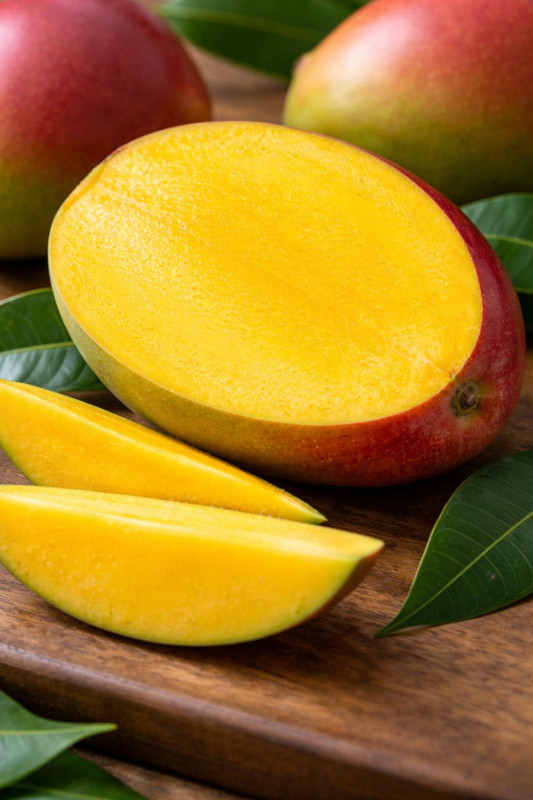
Fiberless is a practical eating-quality description for mango flesh with little noticeable stringiness, not a claim that the fruit contains absolutely no structural or dietary fiber. The amount perceived depends on cultivar, ripeness, and which part of the flesh is sampled. Low-fiber flesh can be pleasant for fresh eating, but texture is only one aspect of quality. Compare sound fruit at similar stages and avoid assuming that a smooth sample alone identifies a variety or guarantees a particular flavor.

Fiberless is a relative description of eating texture rather than a guarantee that no structural tissue exists in the fruit. Compare the cheeks and the area near the seed, because strands may be distributed unevenly. A fruit can feel smooth at eating ripeness while still containing the cell-wall materials that contribute dietary fiber.

Read more about Fiberless
Fibrous

Fibrous

Fibrous describes mango flesh containing noticeable string-like strands, often most prominent around the seed. These strands include vascular tissue and affect mouthfeel; their presence does not by itself mean the fruit is spoiled, nutritionally poor, unsafe, or an inferior cultivar. Describe where the strands occur and how strongly they affect eating texture rather than simply labeling a fruit bad.

Preferences and uses differ. Some people enjoy more fibrous mangoes, while others favor smooth dessert flesh. Drinks and cooked preparations may tolerate the strands or remove them by straining. Compare sound fruit at a similar eating-ripe stage and evaluate sweetness, acidity, aroma, firmness, and overall condition separately from stringiness. Visible strands are also not a measurement of the fruit's total dietary fiber.

Read more about Fibrous
Field Capacity (generated editorial illustration)

Field Capacity

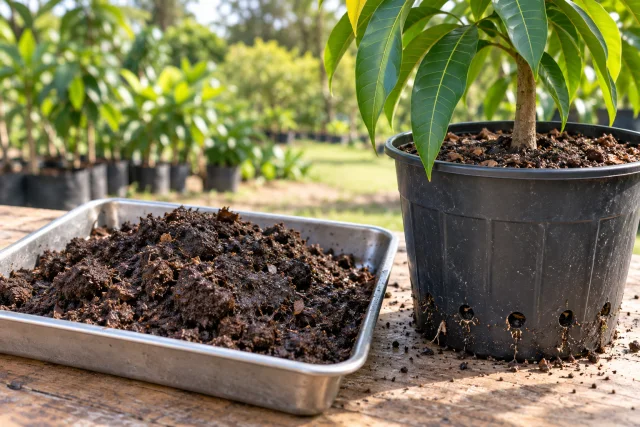
Field capacity describes the soil moisture remaining after substantial gravitational drainage has slowed. It is a useful reference for irrigation planning, not a fixed moisture percentage shared by every soil. A mango root zone can hold very different amounts of plant-available water depending on texture, structure, and rooting depth. A sensor reading is most useful when interpreted for the actual soil and placement. Do not equate field capacity with continuous saturation, which leaves much less air available to roots.

The reference condition is reached after rapid drainage diminishes, not after every pore has emptied. Water remains held within the soil, with its quantity and availability influenced by pore sizes and soil properties. Establishing a local sensor reference after drainage can be more useful than applying a moisture percentage taken from another site.

Read more about Field Capacity

Firmness

Firmness describes a fruit's resistance to deformation or penetration. Mango firmness generally changes during ripening, but readings depend on the instrument, measurement location, peel treatment, temperature, and fruit condition. Gentle handling observations and laboratory measurements are not interchangeable units. When comparing fruit, describe how firmness was assessed and its ripeness stage. A soft spot caused by a bruise or internal breakdown should be distinguished from even, normal softening across an otherwise sound fruit.

Different measuring methods answer different questions. A gentle hand assessment describes practical eating condition, while a penetration test uses specified equipment and preparation. Report the method with any number, and compare similarly prepared fruit so that a difference in peel handling or measurement position is not mistaken for a cultivar effect.

Further reading: UC Davis: Mango Postharvest Resources.

Read more about Firmness
Flushing

Flushing

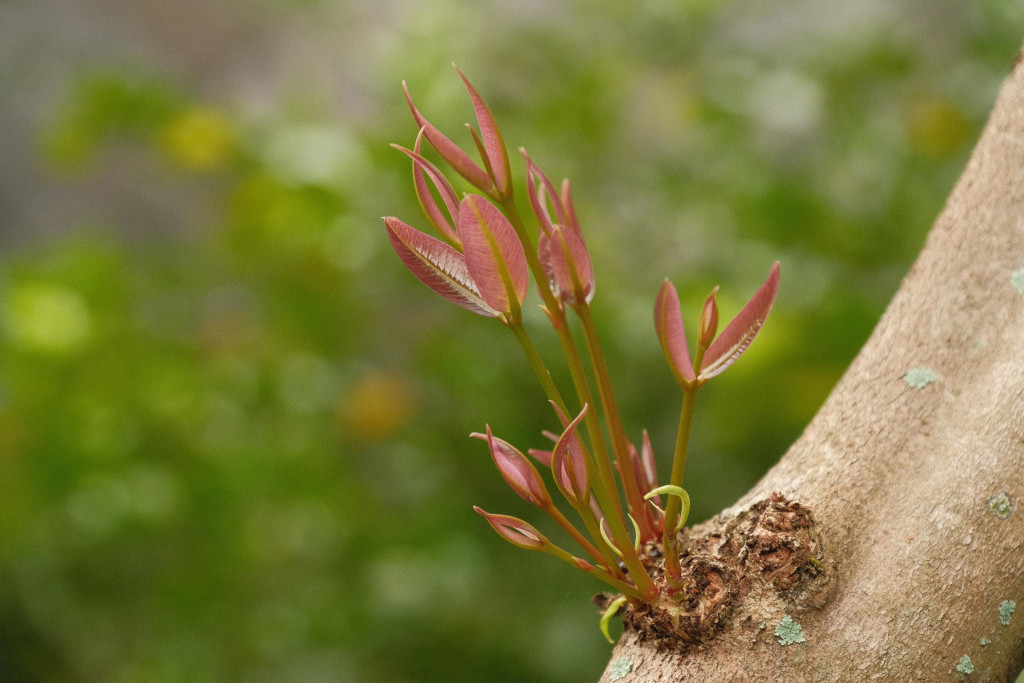
Flushing is the production of a new burst of shoots and leaves, rather than steady growth throughout the year. Mango leaves often emerge bronze, reddish, or pale green and become firmer and darker as they mature. A flush helps build the canopy and provides shoots that may later flower, but a late vegetative flush can compete with flowering. Record when growth starts and hardens before deciding when to prune or fertilize; the calendar varies with climate and tree condition.

A flush is also a useful unit for describing shoot development. Marking the start of growth, leaf expansion, and hardening on a particular branch distinguishes a succession of flushes from one continuous shoot. Compare terminal shoots around the canopy rather than judging the whole tree from one shaded or unusually vigorous branch.

Read more about Flushing
Fruit Retention (generated editorial illustration)

Fruit Retention

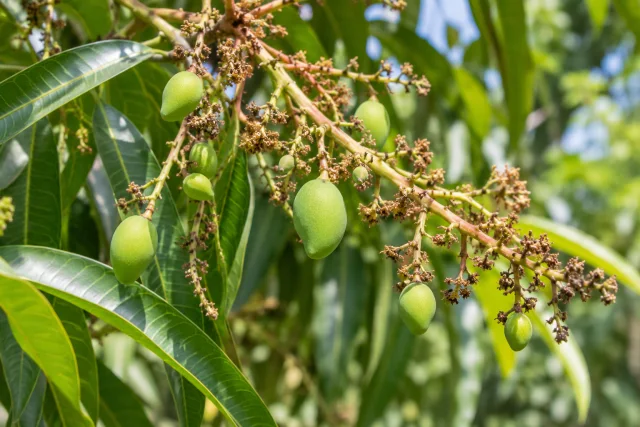
Fruit retention is the continued holding of developing fruit after initial set. A mango tree normally sheds many flowers and small fruitlets, so retention should be considered relative to stage, tree size, and normal behavior. Unusual losses can follow stress, disease, injury, or competing demands within the tree. Maintain suitable root-zone conditions and investigate the pattern rather than treating every fallen fruitlet as a nutrient deficiency or assuming a spray can preserve every fruit that initially sets.

Retention can be recorded as the proportion remaining from an earlier, clearly defined count. Specify both observation dates or developmental stages. Otherwise, percentages from different trees may not be comparable, and a count made before normal early drop can appear worse than one begun only after the crop has already thinned naturally.

Read more about Fruit Retention