This site contains affiliate links for which we may be compensated.

Mango Database
Mangoes in a sunlit tropical orchard

Mango Glossary

Understand the language of mango growing, one term at a time.

Explore Mango Terminology

Browse definitions and growing concepts to expand your mango knowledge.

Showing 1–7 of 18 terms

Cleft Grafting

Cleft grafting inserts a wedge-shaped scion into a split at the cut end of a stock or branch. In mango work, matching the living cambial regions along at least one suitable edge is more important than placing a thin scion exactly in the middle of a thick stock. Secure the join and protect exposed surfaces from drying and water entry. A successful technique on one stem size or season should not be treated as a guarantee for every tree.

A cleft provides a place to seat a prepared scion, but the split alone does not establish cambial contact. Positioning must account for the thickness of bark and wood on both pieces. Protect the completed work from movement and drying, then assess the emerging shoot and union before relaxing support.
Read more about Cleft Grafting
Callus (generated editorial illustration)

Callus

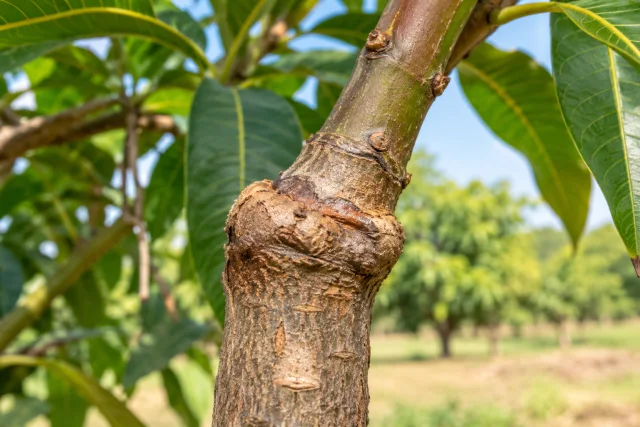
Callus is tissue formed as plant cells divide in response to injury or certain propagation conditions. At a mango graft it contributes to healing around the joined surfaces, but a visible swelling is not proof of a complete vascular connection. A scion can open buds briefly using stored reserves before failing. Judge graft success by sustained healthy growth and a sound union over time, while preventing wrapping material from becoming a constricting band.

Callus is a wound response, while a functioning graft also requires organized connections between the joined partners. A conspicuous swelling therefore should not be treated as proof of successful transport. Continue observing sustained growth and structural condition, and distinguish healthy wound development from decay or constriction hidden beneath a wrap.

Read more about Callus

Cambium

Cambium is a thin region of actively dividing cells between the inner bark and the wood of a woody stem. During mango grafting, close alignment of living cambial regions helps the scion and rootstock form a functioning connection. Matching outer bark alone may not provide that contact when stems differ in thickness. Clean cuts, secure wrapping, and protection from movement support healing; pushing two cut surfaces together does not guarantee that their living tissues are correctly aligned.

The cambium produces vascular tissues associated with increasing stem thickness. During union formation, alignment is a practical way to bring appropriate living regions into contact, not a requirement that bark surfaces line up perfectly everywhere. When diameters differ, suitable alignment on one side can matter more than centering the outer outlines.

Read more about Cambium

Canker

A canker is a localized area of dead tissue on a stem, branch, or trunk, often involving bark and underlying tissues. It is a symptom description rather than the name of one pathogen. On mango, document its position, progression, associated cracking or exudate, and the condition of nearby growth. Physical injury and several disease processes can produce superficially similar damage, so identifying a canker does not by itself establish which treatment or pruning response is appropriate.

A canker may have a distinct margin between affected and apparently healthy tissue, but appearances change as the injury develops. Note whether a branch above it declines and whether similar areas occur elsewhere. Those observations help establish the extent of the problem without assuming that every bark depression shares one cause.

Further reading: Purdue: Symptoms and Signs for Plant Problem Diagnosis.

Read more about Canker
Canopy Management

Canopy Management

Canopy management is the deliberate control of a tree's size, branching, and distribution of foliage. In mangoes it supports light penetration, airflow, safe harvest, and access for monitoring rather than simply making the tree look neat. Training young trees and making modest, well-timed cuts can prevent the need for drastic height reduction later. Removing too much foliage or pruning shortly before flowering can reduce production, so management must balance useful canopy size with retained productive shoots.

Canopy management includes the arrangement of productive shoots, not merely the height of the tallest branch. An open access route, useful light distribution, and manageable picking positions may require different cuts. Evaluate regrowth after an operation, because removing volume once does not guarantee that the next canopy will have a better structure.

Read more about Canopy Management
Carbon Sequestration

Carbon Sequestration

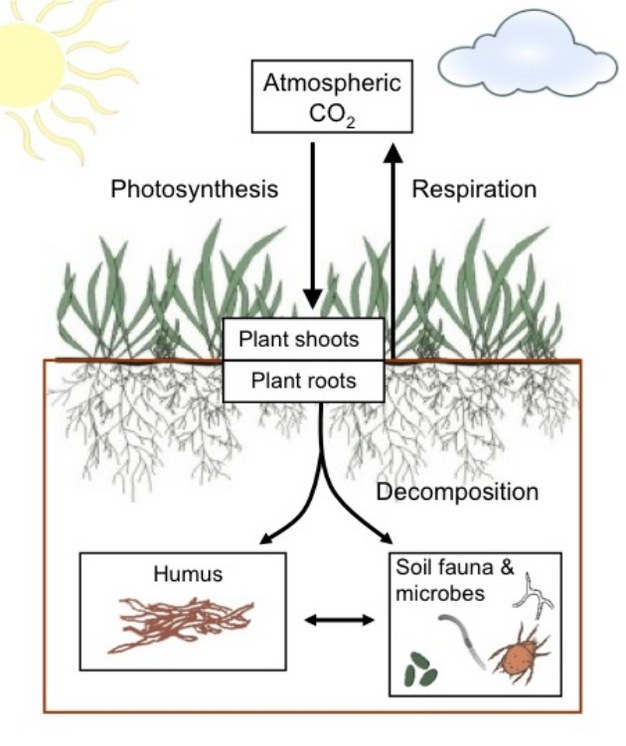
Carbon sequestration is capture and storage of carbon in a longer-lived pool such as woody biomass or soil organic matter. Mango trees incorporate atmospheric carbon into their tissues as they grow, and management influences whether stored carbon persists or returns to the atmosphere. Net climate effects also depend on land-use history, inputs, transport, and eventual tree removal. Planting a mango is therefore not a measured carbon offset by itself; credible comparisons require a defined baseline and accounting period.

Stored carbon and the rate of additional storage are different measurements. A mango tree contains carbon in its living tissues, while orchard soils and management practices also influence the wider balance. Quantifying a climate benefit requires defined boundaries and measurements over time rather than multiplying a tree count by an unsupported universal value.

Read more about Carbon Sequestration

Cell Turgor

Cell turgor is the pressure of a cell's contents against its wall as water enters and is retained. It helps keep nonwoody plant tissues firm. A mango leaf can lose firmness when water uptake does not keep pace with loss, but that imbalance may arise from dry soil, damaged roots, or other stresses. Inspect the root environment before responding to wilting with repeated watering, since saturated soil can impair roots while leaves still look thirsty.

The vacuole and other cell contents contribute to pressure within a living cell, while the wall limits expansion. Loss of that pressure can make soft tissues droop before they are permanently damaged. Recovery still depends on functioning roots and suitable conditions; persistent collapse can reflect more than a temporary midday imbalance.

Further reading: Oregon State University: soil moisture monitoring.

Read more about Cell Turgor