This site contains affiliate links for which we may be compensated.

Mango Database
Mangoes in a sunlit tropical orchard

Mango Glossary

Understand the language of mango growing, one term at a time.

Explore Mango Terminology

Browse definitions and growing concepts to expand your mango knowledge.

Showing 1–4 of 4 terms

Immobilization

Immobilization incorporates inorganic nutrients into living microbial biomass or other organic forms, temporarily reducing their immediate availability to plants. During decomposition, microbes may use soil nitrogen to process residues that contain relatively little nitrogen. This is different from nutrients being permanently destroyed. In mango care, distinguish surface mulch management from mixing large amounts of fresh, high-carbon material through the root zone, and interpret a growth change using both the material's placement and the wider nutritional conditions.

Immobilization and mineralization can occur in the same soil at the same time in different materials and locations. Their balance changes as residues decompose and conditions shift. A fresh wood-rich amendment mixed into soil presents a different situation from an older surface mulch, so placement and decomposition stage should accompany descriptions of a response.

Further reading: University of Missouri: Mineralization and Immobilization.
Read more about Immobilization
Infiltration (generated editorial illustration)

Infiltration

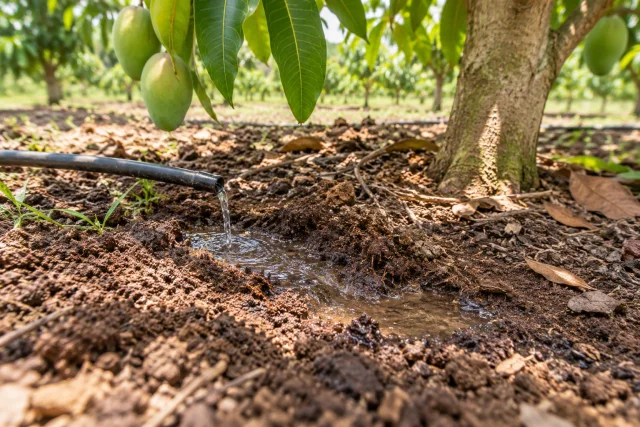
Infiltration is the entry of water through the soil surface. It differs from drainage, which includes movement through and out of the root zone after water enters. For a mango, slow infiltration can cause runoff while fast infiltration may still lead to saturation above an underground barrier. Check both surface behavior and moisture at root depth when planning irrigation. A puddle's disappearance alone does not prove that the whole planting site is adequately drained.

Infiltration is measured at the surface, but irrigation also depends on what happens after entry. Water may spread sideways above a restrictive layer or move beyond shallow roots. Observe moisture at several depths and positions so that a fast surface intake is not mistaken for uniform wetting of the whole root zone.

Read more about Infiltration
Integrated Pest Management (generated editorial illustration)

Integrated Pest Management

Integrated pest management, or IPM, combines identification, monitoring, prevention, and appropriately selected controls rather than relying on a routine spray schedule. For mangoes it means considering crop stage, actual damage, natural enemies, sanitation, and growing conditions before intervening. Chemical tools may have a role when justified and legally appropriate, but they are not the definition of the system. Record what was observed and the result of each action so future decisions are based on evidence rather than habit.

Monitoring provides a basis for deciding whether a problem is increasing and whether intervention is justified. Define the observation method and management objective first, then compare the result after an action. A system based on records can retain effective practices while avoiding repeated treatments that did not address the diagnosed cause.

Read more about Integrated Pest Management

Irrigation Scheduling

Irrigation scheduling determines when to irrigate and how much water to apply. It combines soil or substrate conditions, rooting depth, weather, tree development, and the irrigation system's output. Mango water needs change with tree size, location, and season, so a single calendar schedule is rarely suitable everywhere. Check that water reaches the root ball and surrounding roots without prolonged saturation, and adjust after rainfall or changes in canopy size instead of adding water automatically.

The amount delivered is the actual application rate multiplied by operating time, adjusted for the system's arrangement and losses. Frequency and duration solve different parts of the problem. Checking moisture after irrigation helps determine whether water reached useful depth, remained localized, or passed beyond the portion of soil the tree actively explores.

Further reading: University of Minnesota: Irrigation Management Strategies.

Read more about Irrigation Scheduling