

This site contains affiliate links for which we may be compensated.

Mango Database
Mangoes in a sunlit tropical orchard

Mango Glossary

Understand the language of mango growing, one term at a time.

Explore Mango Terminology

Browse definitions and growing concepts to expand your mango knowledge.

Showing 1–7 of 7 terms
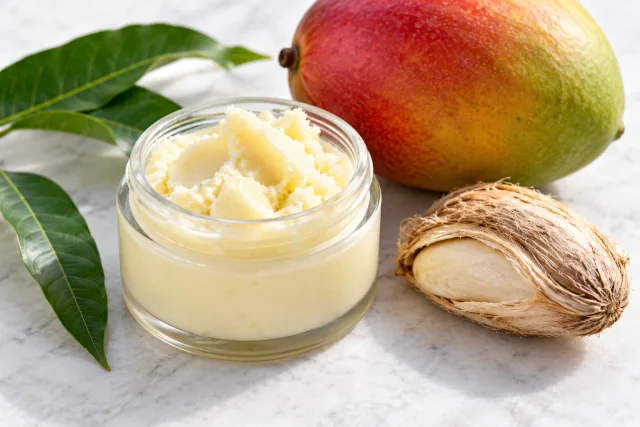
Mango Butter (generated editorial illustration)

Mango Butter

Mango butter is a fat obtained from mango seed kernels and used as an ingredient in some cosmetic formulations. It is different from mango pulp, mango juice, or a fruit-flavored spread, and its properties depend on processing and formulation. A cosmetic ingredient should not be presented as a proven treatment for skin disease merely because it is plant-derived. Read the product's intended use and ingredients, and do not assume a cosmetic-grade material is suitable for eating or home food preparation.

The word butter describes the texture and commercial use of an extracted fat, not a dairy ingredient or the soft texture of ripe mango flesh. Product composition may vary with refining and blending. Keep cosmetic product descriptions separate from horticultural claims and do not infer treatment benefits merely from a mango-derived ingredient.

Read more about Mango Butter

Mango Flowering Cycle

The mango flowering cycle is the sequence leading from suitable mature shoots through flower initiation, panicle emergence, bloom, and early fruit development. Timing responds to climate, shoot age, cultivar, and tree condition, so the same calendar is not valid worldwide. A shoot that is still actively producing leaves may not be ready to flower when nearby mature shoots do. Record local patterns over several seasons and consider pruning and growth timing rather than trying to trigger flowering with one universal treatment.

Record flowering as a sequence: shoot growth and maturation, visible panicle emergence, opening flowers, and subsequent fruit development. A calendar date alone does not describe the whole cycle. Local temperatures, tree condition, and cultivar behavior can shift stages, making observations of marked shoots useful when comparing seasons.

Read more about Mango Flowering Cycle

Mango Malformation Disease

Mango malformation disease produces abnormal, compact growth in shoots or flower clusters and is associated with Fusarium pathogens, including Fusarium mangiferae. Affected panicles may be thickened, crowded, and poorly fruitful instead of developing normally. Similar-looking growth needs careful identification because not every distorted shoot has the disease. Avoid using suspect trees as sources of propagation material, seek local diagnostic advice, and manage affected material according to local guidance rather than moving it between collections.

Abnormally compact flower clusters and distorted vegetative growth should be documented separately. A malformed panicle is not the same as ordinary variation in flower number or the loss of flowers after a storm. Avoid exchanging suspect propagation material until the cause is investigated, and keep source records for newly introduced trees.

Read more about Mango Malformation Disease

Mealybugs

Mealybugs are sap-feeding insects often recognized by white waxy coverings or cotton-like masses. On mango they may gather on tender shoots, flower clusters, or fruit and produce honeydew that supports sooty mold. Ants can protect honeydew-producing insects from natural enemies, so inspect for both. Identification matters because shed skins, harmless wax, and other insects can look similar at a distance. Start with close monitoring and appropriate cultural or biological measures instead of applying broad treatments to every white patch.

Individuals may shelter in protected sites such as leaf axils, crowded shoots, and fruit attachments, where a distant canopy inspection can miss them. Their waxy covering and egg masses differ from plant hairs or mineral deposits. Examine several affected and apparently unaffected shoots to understand the distribution rather than judging severity from one cluster.

Read more about Mealybugs

Meristem

A meristem is a region containing cells capable of continued division and the production of new plant tissues. Different meristems contribute to lengthening shoots and roots or to increasing stem thickness. A mango tree's growth depends on the survival and activity of these regions, which may be damaged by cold, injury, or disease. The word describes a tissue's developmental role; it is not a synonym for a visible bud, a swollen graft union, or wound callus.

Meristematic tissue produces new cells, while those cells subsequently differentiate into particular structures and functions. Position and developmental role matter: a root tip, a shoot tip, and a vascular cambium are not interchangeable. Knowing the distinction helps interpret propagation language without treating every region of active growth as the same tissue.

Further reading: Washington State University: Basic Botany.

Read more about Meristem

Mesocarp

The mesocarp is the middle layer of the fruit wall, between the outer skin and the inner endocarp. Most of a mango's edible flesh belongs to this layer. Its firmness, water content, pigments, and cell-wall properties change as fruit develops and ripens. Describing the mesocarp helps distinguish a flesh characteristic, such as stringiness or internal softening, from a surface blemish on the peel or damage confined to the stone surrounding the seed.

The mesocarp's texture reflects cell contents, cell-wall properties, and tissue organization. The visible strings associated with some mangoes are not a measurement of every component of that tissue. Describe normal ripening changes separately from localized watery, spongy, or decayed regions when recording the quality of cut fruit.

Further reading: OpenStax: fruit and seed development.

Read more about Mesocarp

Monoembryonic

Monoembryonic describes a seed containing one embryo. In mango, that embryo normally develops through sexual reproduction after fertilization, so its genetic makeup can differ from the mother tree even when the pollen comes from the same cultivar. A seedling therefore cannot be assumed to reproduce the named fruit from which the seed came. Use a verified grafted tree when a particular cultivar is the goal; grow seedlings for experimentation or suitable rootstocks with realistic expectations about variation.

A single seedling can be useful as a rootstock or as a new selection, but those are different goals from preserving a cultivar. Label it as a seedling of the known seed parent and keep the collection date. The eventual fruit must be evaluated on its own merits before any identity or performance claim is made.

Read more about Monoembryonic