

This site contains affiliate links for which we may be compensated.

Mango Database
Mangoes in a sunlit tropical orchard

Mango Glossary

Understand the language of mango growing, one term at a time.

Explore Mango Terminology

Browse definitions and growing concepts to expand your mango knowledge.

Showing 1–7 of 7 terms

Newbie

Newbie is an informal name for someone new to a subject, including mango growing. It has the same everyday sense as noob, but is not a horticultural classification. New growers benefit from learning to distinguish seedlings from grafted trees, checking drainage before watering again, and identifying pests before choosing a treatment. When seeking advice, give climate and growing-condition details instead of assuming that a schedule used by another grower will work unchanged in a different location.
Read more about Newbie

NGRP

NGRP stands for National Genetic Resources Program, the USDA program encompassing conservation of genetic resources important to agriculture. Plants are one part of that wider effort, alongside other kinds of agricultural genetic resources. For mango growers, the practical connection is preservation of living diversity and the information needed to use it in research or breeding. NGRP is not a cultivar, certification label, or nursery rating. Its relationship with GRIN and the National Plant Germplasm System explains why those abbreviations often appear together.

Read more about NGRP
Node (generated editorial illustration)

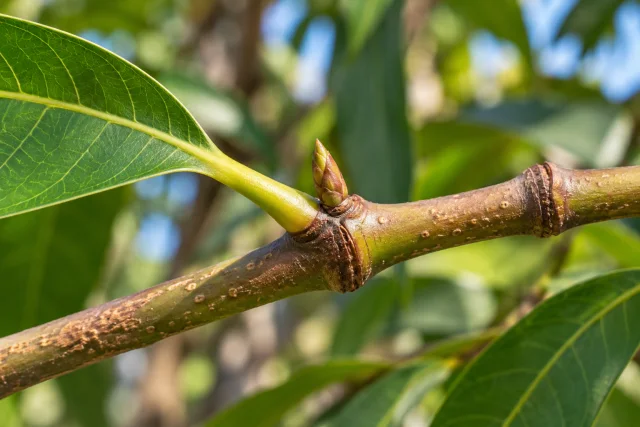
Node

A node is a point on a stem where a leaf or leaves attach and where associated buds may occur. Nodes help a grower describe mango shoot structure and locate potential new growth. They are different from the internodes between them. When making training or propagation cuts, recognize the actual bud and tissue condition instead of assuming every mark on the bark will produce a shoot. Damaged or inactive buds may not respond as expected after pruning.

Nodes provide a useful reference for describing where leaves, buds, and new growth are attached. Counting them can help explain a training cut or document a shoot's development. Include the attachment points in photographs, because a close-up of an isolated stem segment may omit the structures needed to interpret its orientation.

Read more about Node

Noob

Noob is informal internet slang for a newcomer. In mango discussions it describes a person's experience level, not a type of tree or a technical growing method. A beginner can get more useful help by describing the tree's location, age, propagation method, pot or soil conditions, and symptoms, preferably with clear photographs. The label should not discourage questions: basic checks such as drainage, light, and root-ball moisture often matter more than complicated treatments when learning to grow mangoes.

Read more about Noob

Nubbin

Nubbin is a grower's term for an unusually small mango, often associated with an absent or poorly developed seed. It describes the resulting fruit rather than proving a single cause such as lack of insects or a particular weather event. Some nubbins can persist on a tree while normal fruit develops alongside them. Cut representative fruit when investigating the problem and consider flowering conditions and seed development before deciding that all small mangoes reflect insufficient fertilizer or a new cultivar.

A nubbin should be described by its actual size, shape, and internal development rather than treated as a new cultivar name. Compare it with normal fruit from the same tree and stage. An occasional small mango does not establish a stable fruit type, and its appearance alone cannot explain the developmental event that produced it.

Read more about Nubbin

Nucellar Embryony

Nucellar embryony is embryo formation from maternal nucellus tissue rather than from a fertilized egg. It explains why a polyembryonic mango seed can contain embryos genetically matching the mother tree alongside a sexually produced embryo. The term identifies the embryo's origin, whereas polyembryony describes the presence of multiple embryos. Do not select a supposed nucellar seedling solely by its size or emergence order; those visible features are not a dependable identity test for every seed.

The nucellus is maternal tissue associated with the ovule, making nucellar embryos different in origin from an embryo formed after fertilization. Multiple embryos can coexist in a mango seed. Keep that biological distinction separate from an informal grower's rule about which visible sprout must be clonal; external vigor does not reliably reveal embryo origin.

Read more about Nucellar Embryony

Nurse Branch

A nurse branch is a branch temporarily retained during certain grafting or topworking operations to support the plant while replacement growth establishes. Its purpose and removal schedule depend on the method and tree condition. On a mango being converted to another cultivar, retained growth must be managed so that it does not overwhelm new scions. Do not assume every shoot below a graft is beneficial; identify which branch was deliberately retained and which shoots are unwanted competition.

A nurse branch supports the tree during a transition, but retaining it indefinitely can compete with the intended replacement canopy. Its role should be documented as part of the grafting plan. Monitor the new scions and retained branch separately so that stock growth is not mistaken for successful establishment of the new cultivar.

Further reading: University of Minnesota: Grafts and Wounds.

Read more about Nurse Branch