This site contains affiliate links for which we may be compensated.

Mango Database
Mangoes in a sunlit tropical orchard

Mango Glossary

Understand the language of mango growing, one term at a time.

Explore Mango Terminology

Browse definitions and growing concepts to expand your mango knowledge.

Showing 1–7 of 14 terms

Radicle

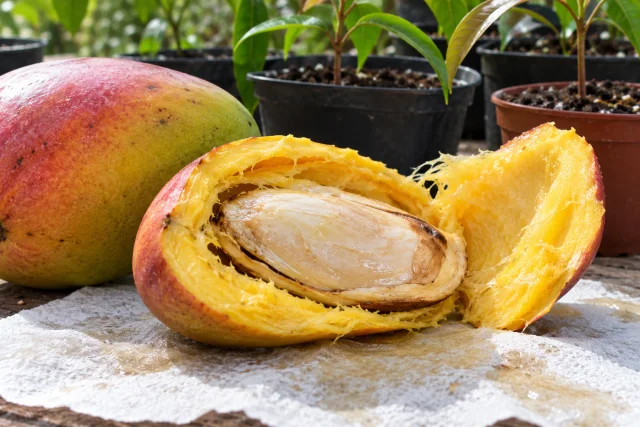
The radicle is the embryonic root that develops into the seedling's primary root during germination. Recognizing it helps growers position and handle a germinating mango seed without mistaking the emerging root for a shoot. It is delicate and should not be bent sharply or left exposed to drying air. Once root growth begins, provide a clean, well-drained growing medium and sufficient container depth rather than repeatedly lifting the seed to inspect its progress.

The first root establishes a connection with the growing medium, after which branching increases the explored volume. Physical damage at this early stage can matter even when the seed still appears sound. Prepare the container before handling a germinating mango so that the exposed root spends as little time as possible unsupported or drying.

Further reading: World Agroforestry: Mangifera indica.
Read more about Radicle
Recalcitrant Seed (generated editorial illustration)

Recalcitrant Seed

A recalcitrant seed is sensitive to substantial drying and does not tolerate ordinary dry, frozen seed-bank storage. Mango seed belongs to this general category, which helps explain why freshly handled seed is normally preferable to old, dried seed for propagation. This is different from a hard seed coat that merely delays germination. Protect the living embryo from drying and damage, but do not confuse moisture protection with keeping it in stagnant conditions that encourage decay.

Conservation of mango material therefore often relies on living collections and other specialized approaches rather than conventional packets of dry seed. For a grower, prompt handling and accurate labeling are practical priorities. Keeping a seed moist does not establish a dependable long-term storage method, and the condition of the living embryo remains central.

Read more about Recalcitrant Seed

Redbanded Thrips

Redbanded thrips, Selenothrips rubrocinctus, is a thrips species that can damage mango foliage through feeding. Its immature stages have a characteristic reddish band, although confident identification requires more than a distant color impression. Feeding injury may include discoloration or bronzing, with other evidence helping distinguish it from nutrient or weather damage. Check both leaf surfaces and the insects present, and avoid assuming that every thrips species or every bronze leaf represents this particular pest.

Life-stage appearance is useful evidence, but photographs should also show the insects' size and the affected tissue. Old feeding injury can remain after a population has declined. Separate observations of active insects from residual discoloration so that a persistent bronze patch is not automatically counted as continuing damage.

Further reading: UF/IFAS: Mango Insect Pests and Beneficials.

Read more about Redbanded Thrips
Refractometer (generated editorial illustration)

Refractometer

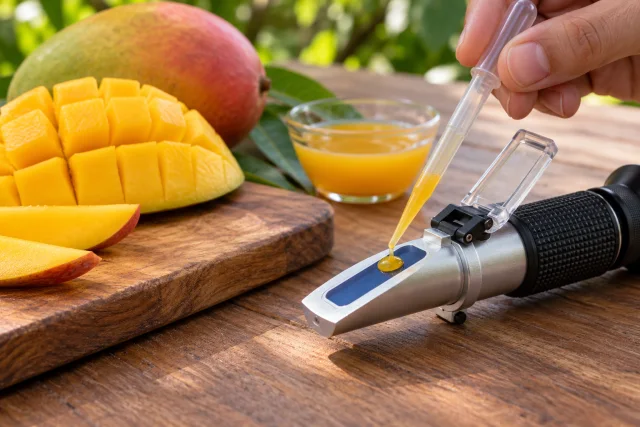
A refractometer measures how light bends through a sample and can estimate soluble solids in mango juice on a Brix scale. Clean optics, calibration, temperature compensation, and consistent sampling improve comparisons. The reading is influenced by dissolved substances other than sugars, so it is not a complete flavor analysis. A useful tasting record combines the instrument reading with ripeness, acidity, aroma, and texture rather than using one number to rank every mango or identify a cultivar.

A small juice sample should represent the fruit or sampling objective being compared. Water left on the instrument or material carried over from another sample can alter readings. Document calibration and sampling location, and report the measurement alongside the fruit's condition rather than interpreting decimal precision as proof of biological certainty.

Read more about Refractometer

Respiration

Respiration is the process by which living tissues use stored compounds and oxygen to release energy, producing carbon dioxide and water. Harvested mangoes remain alive and continue respiring as they ripen. Temperature and fruit condition influence the rate, which helps explain changes in storage life and the need for suitable handling. Slowing respiration is not the same as stopping deterioration, and enclosing fruit without adequate gas exchange can create off-flavors or injury instead of preserving quality.

The fruit continues using its own reserves after separation from the tree. Changes in temperature and gas conditions can alter that metabolism, but suppressing normal processes too strongly can injure the fruit. A storage strategy therefore balances slower deterioration with the living tissue's need for an atmosphere and temperature it can tolerate.

Read more about Respiration
Ripening Stage (generated editorial illustration)

Ripening Stage

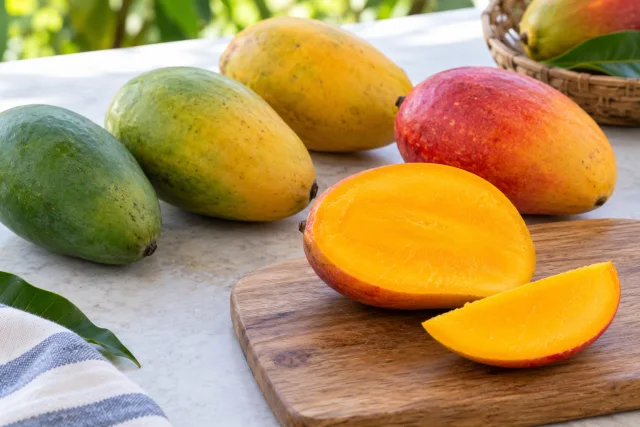
Ripening stage describes how far a fruit has progressed toward its characteristic eating quality. In mangoes, firmness, aroma, flesh texture, and internal color change during ripening, while peel color can be a poor guide for some cultivars. Harvest maturity and eating ripeness are different: a mature but firm fruit may ripen successfully after picking. Describe the actual condition of the fruit when comparing flavors or storage results, because a cultivar sampled too early can give a misleading impression.

A ripening description can separate external color, flesh firmness, aroma, and internal color rather than assign one vague label. These characteristics do not always change in perfect synchrony. Recording the stage at sampling makes a tasting comparison more informative than attributing every difference between two fruit to their cultivar names.

Read more about Ripening Stage

RKN

RKN stands for root-knot nematode, a group of microscopic plant-parasitic roundworms in the genus Meloidogyne. They feed in roots and can cause swellings or galls, reducing effective root function in susceptible plants. Above-ground symptoms such as weak growth are not diagnostic because many root problems look similar. For a mango with suspect roots, use a plant-diagnostic or nematode test and obtain clean nursery material; not every soil nematode is harmful or requires treatment.

Root-knot damage concerns the interaction between a particular nematode and a susceptible host. Root swellings can persist after conditions change, while stressed foliage may have several simultaneous causes. Submit representative roots and soil according to the diagnostic laboratory's instructions; a handful of dry surface soil may not reveal the problem affecting fine roots.

Read more about RKN