

This site contains affiliate links for which we may be compensated.

Mango Database
Mangoes in a sunlit tropical orchard

Mango Glossary

Understand the language of mango growing, one term at a time.

Explore Mango Terminology

Browse definitions and growing concepts to expand your mango knowledge.

Showing 1–7 of 7 terms
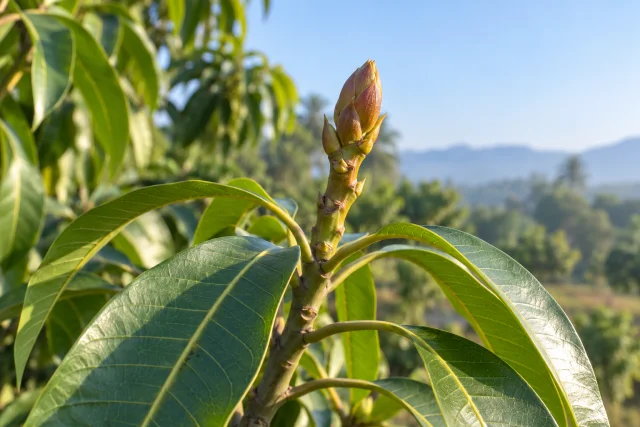
Terminal Bud (generated editorial illustration)

Terminal Bud

A terminal bud is located at the end of a shoot. Mango terminal growth is important because many flower panicles develop at shoot tips after the shoots reach an appropriate state. Removing those tips at the wrong time can remove potential bloom sites or stimulate new leaves instead. Observe whether the terminal is resting, producing leaves, or developing a panicle before pruning, and relate that observation to local flowering patterns rather than using one worldwide calendar.

A terminal bud's position describes where it sits, not a guarantee that it will produce flowers. Its developmental fate depends on the shoot and conditions. Distinguish a resting tip from an emerging panicle or a new leafy flush when keeping mango records, and avoid interpreting every swollen terminal structure as an approaching crop.
Read more about Terminal Bud

Testa

The testa is the seed coat, a covering that belongs to the seed itself rather than to the surrounding fruit wall. In mango, it lies inside the hard stone and surrounds the embryo and its cotyledons. This distinction matters when discussing seed preparation: removing the woody husk does not mean that every remaining layer should be peeled away. Handle exposed seeds gently, since damage and drying can interfere with successful germination.

The testa belongs to the seed, while the surrounding stone belongs to the fruit wall. Those coverings can differ greatly in toughness and appearance. Naming the layers accurately helps explain propagation instructions and prevents the assumption that a seed with its woody husk removed is simply a bare, unprotected embryo.

Further reading: World Agroforestry: Mangifera indica.

Read more about Testa

Thrips

Thrips are tiny insects that can feed on mango flowers, young leaves, or developing fruit, depending on the species. Feeding may leave scarring or distorted tissue, but the symptoms can resemble damage from other causes. Not every thrips found on a plant is equally harmful, and insects in flowers should be identified before action. Monitor fresh injury and crop stage, consider natural enemies, and avoid assuming that a broad spray during bloom is justified by the presence of any small insect.

Thrips life stages and feeding sites can differ, making the crop's developmental stage important in scouting. Damage to a young organ may remain visible after the insects have moved. Inspect fresh growth and distinguish current feeding from old scars before concluding that a large population is still present.

Read more about Thrips

Topworking

Topworking changes the cultivar carried by an established tree by grafting selected scions onto suitable branches or regrowth. On mangoes it can replace an unsatisfactory selection or create a multi-cultivar tree without starting with a new root system. The operation needs planning for branch structure, exposed bark, vigorous competing shoots, and the balance of new grafts. Large cuts and heavy canopy removal create risks, so an established tree should not be stripped indiscriminately in pursuit of a quicker crop.

The old framework and root system remain, while selected aboveground growth is replaced with new cultivars. This creates different demands from grafting a small nursery seedling. Plan where replacement branches will grow, manage competing stock shoots, and retain a clear map of the new cultivars as the canopy is rebuilt.

Read more about Topworking
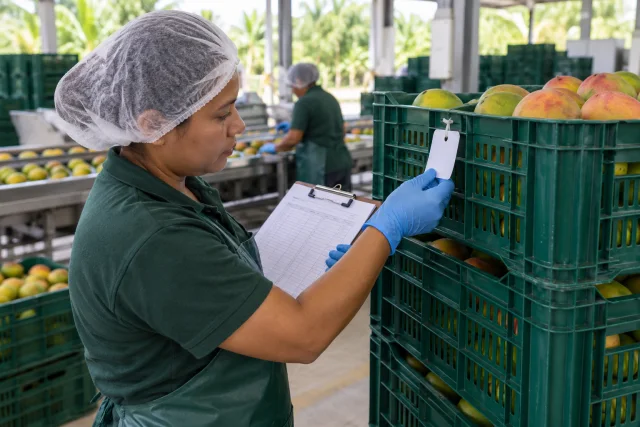
Traceability (generated editorial illustration)

Traceability

Traceability is the ability to follow a product or plant material through documented stages of its history. Mango fruit records may connect an orchard block, harvest date, packing batch, and customer, while nursery records can connect a graft to its scion source and rootstock batch. Useful traceability requires labels and records that remain linked as material moves. It supports investigation and quality control but does not independently prove a cultivar claim or replace inspection for pests and disease.

A record becomes useful when its identifier remains attached as material is divided or combined. For propagation, that can mean connecting an individual graft to a labeled scion source; for fruit, it may mean retaining a harvest lot through packing. A label without the corresponding records offers much less traceability.

Read more about Traceability

Transpiration

Transpiration is the loss of water vapor from a plant, predominantly through leaf stomata. It is connected to the movement of water from roots through the canopy and is affected by light, humidity, wind, and temperature. A mango in a windy, exposed container can therefore dry differently from one in a sheltered site. Judge watering needs from the root zone and growing conditions, rather than using leaf size or a fixed calendar as the only guide.

Transpiration can change rapidly with wind, humidity, light, and the opening of stomata. The roots must supply the resulting demand through the plant's transport system. Comparing a sheltered morning with a windy afternoon therefore requires more context than noting that the same pot received the same amount of water on both occasions.

Further reading: Oregon State University: Botany Basics.

Read more about Transpiration
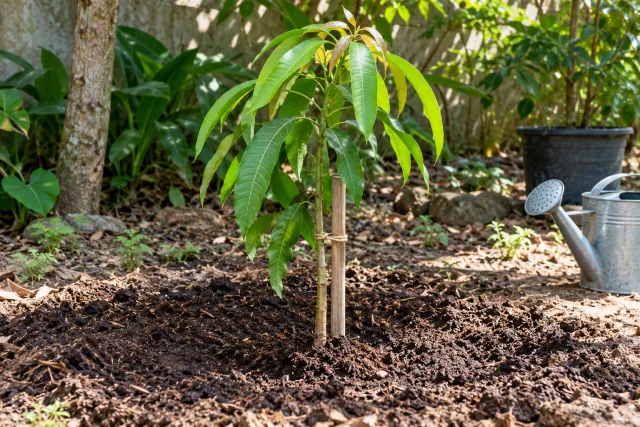
Transplant Shock (generated editorial illustration)

Transplant Shock

Transplant shock is a temporary setback following movement or planting, often caused by disturbed roots, changed water supply, and a sudden change in exposure. A mango may wilt, drop leaves, or pause growth even when it has not acquired a new disease. Keep the original root ball appropriately moist while avoiding waterlogging and protect the tree from extreme conditions. Heavy fertilizer or drastic pruning is not an automatic cure; observe recovery and investigate persistent decline.

The original root ball may retain a different moisture pattern from the surrounding soil after planting. Check both regions during establishment. A wet surface outside the ball does not prove that its interior is adequately hydrated, and repeated watering of an already saturated ball can compound stress rather than relieve it.

Read more about Transplant Shock