

This site contains affiliate links for which we may be compensated.

Mango Database
Mangoes in a sunlit tropical orchard

Mango Glossary

Understand the language of mango growing, one term at a time.

Explore Mango Terminology

Browse definitions and growing concepts to expand your mango knowledge.

Showing 1–7 of 7 terms
Honeydew (generated editorial illustration)

Honeydew

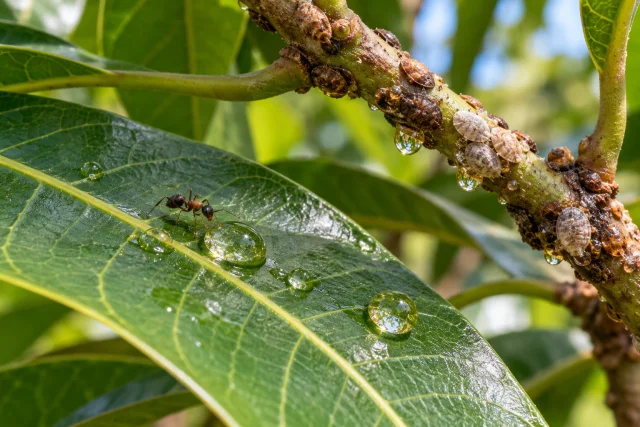
Honeydew is a sugary excretion produced by certain sap-feeding insects, including many mealybugs and soft scales. On mango leaves and fruit it can feel sticky, attract ants, and provide a surface food source for sooty mold. The mold is a consequence of the honeydew rather than proof that a fungus is attacking the leaf tissue internally. Trace the deposit to the insects producing it, and consider ant activity and natural enemies instead of repeatedly washing the surface without addressing the cause.

Sticky deposits can accumulate beneath an infestation, so the insects producing them may be on leaves or branches above the obvious mess. Inspect the surrounding canopy rather than only the coated fruit. Ant attendance and fresh honeydew can provide useful context, but neither substitutes for identifying the sap-feeding insects involved.

Read more about Honeydew

Leaf Hopper

Leaf hopper is a common name for small jumping sap-feeding insects; mango hoppers are particular members of this broader group that can feed on tender growth and flower panicles. Heavy feeding and honeydew can interfere with flowering and fruit set, but species and importance vary by region. Examine insects and fresh damage rather than assuming every small winged visitor is a pest. Pollinating flies and other useful visitors also occur on mango flowers and should not be targeted indiscriminately.

Leafhopper is a broad common name covering insects with different host associations. Adults can move rapidly when disturbed, and immature stages may have a different appearance. Preserve clear close-up photographs or a suitable diagnostic sample, together with the plant part and locality, before interpreting a sighting as a particular mango pest.

Read more about Leaf Hopper

Mealybugs

Mealybugs are sap-feeding insects often recognized by white waxy coverings or cotton-like masses. On mango they may gather on tender shoots, flower clusters, or fruit and produce honeydew that supports sooty mold. Ants can protect honeydew-producing insects from natural enemies, so inspect for both. Identification matters because shed skins, harmless wax, and other insects can look similar at a distance. Start with close monitoring and appropriate cultural or biological measures instead of applying broad treatments to every white patch.

Individuals may shelter in protected sites such as leaf axils, crowded shoots, and fruit attachments, where a distant canopy inspection can miss them. Their waxy covering and egg masses differ from plant hairs or mineral deposits. Examine several affected and apparently unaffected shoots to understand the distribution rather than judging severity from one cluster.

Read more about Mealybugs

Powdery Mildew

Powdery mildew is a fungal disease that can produce whitish growth on susceptible mango flowers, young fruit, and other tissues. Flower infection can reduce fruit set even if the rest of the tree looks vigorous. It is different from sooty mold, which grows on insect honeydew, and should not be diagnosed solely from a distant photograph. Monitor emerging panicles, compare symptoms carefully, and seek locally appropriate guidance before using a product, especially where pollinators are visiting flowers.

A powdery appearance needs to be interpreted with the affected organ and surrounding symptoms. Deposits left by sprays or dust are different from fungal growth, and aging flowers differ from infected ones. Document fresh clusters and their development rather than assessing the entire crop from one old, heavily damaged panicle.

Read more about Powdery Mildew

Scale Insects

Scale insects are sap-feeding insects, many of which become relatively immobile and develop a protective covering. Mango trees can host different kinds, and some honeydew-producing scales encourage sooty mold and ant activity. Other scales do not produce honeydew, so black coating is not a universal symptom. Examine living insects and their distribution before selecting management. Protect natural enemies where possible, and do not mistake every fixed bump on a branch for an active pest.

A protective covering can remain after a scale has died, so the number of visible covers is not necessarily the number of living pests. Monitoring should examine life stages and fresh injury. The distinction between armored and honeydew-producing scales also helps explain why some infestations are associated with sticky leaves and others are not.

Read more about Scale Insects

Sooty Mold

Sooty mold is a dark fungal coating that grows on sticky honeydew deposited by certain sap-feeding insects. On mangoes it can cover leaves, twigs, or peel without being the same disease as anthracnose. Heavy coverage can reduce light reaching leaves and make fruit unattractive. Inspect for scale insects, mealybugs, or other honeydew producers and consider ant activity. Managing the source of honeydew is generally more useful than repeatedly trying to remove the black coating without addressing the insects.

A black surface coating and an expanding lesion within leaf tissue are different observations. Check whether a dark deposit can be distinguished from damaged tissue and inspect nearby insects, sticky surfaces, and ants. Photographing both the coating and the organisms present often provides more diagnostic value than a close-up of darkness alone.

Read more about Sooty Mold

White Mango Scale

White mango scale, Aulacaspis tubercularis, is an armored scale insect that can infest mango leaves and fruit. Attached scale coverings and associated discoloration may affect the appearance of infested tissues, but pale spots alone do not confirm the species. Examine the insects with suitable magnification and compare their arrangement and coverings with a reliable identification reference. Monitoring should distinguish living scales, old coverings, crawler activity, and natural enemies before management decisions are made.

Armored scale coverings are distinct from the exposed body of the living insect beneath them. Old coverings can remain on fruit or leaves after the insect is no longer active. Inspect life stages and fresh damage as well as the visible marks, keeping the distinction from honeydew-producing scales when interpreting associated symptoms.

Further reading: UF/IFAS: Mango Insect Pests and Beneficials.

Read more about White Mango Scale