
This site contains affiliate links for which we may be compensated.

Mango Database
Mangoes in a sunlit tropical orchard

Mango Glossary

Understand the language of mango growing, one term at a time.

Explore Mango Terminology

Browse definitions and growing concepts to expand your mango knowledge.

Showing 1–5 of 5 terms

Leaching

Leaching is movement of dissolved substances downward with water through soil or growing medium. It can carry unwanted salts out of a mango root zone, but can also waste nutrients and contaminate drainage water. Effective salt management requires suitable-quality water and a place for excess water to drain; repeatedly flooding a poorly drained pot is not successful leaching. Interpret the need from water quality, fertilizer history, and testing rather than using extra irrigation as a universal response to weak growth.

Moving salts out of one layer is not the same as removing them from the root environment. Water needs an adequate drainage pathway, and a restrictive layer can leave displaced salts near active roots. Interpret leaching through the soil profile and drainage conditions rather than judging success only by the volume applied at the surface.
Read more about Leaching
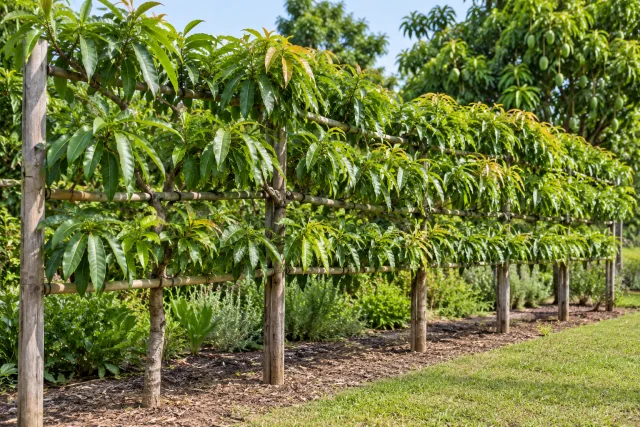
Pleaching (generated editorial illustration)

Pleaching

Pleaching is training and interweaving branches to form a screen or other living structure. Adjacent branches may eventually join where tissues make suitable contact, but simple interweaving does not guarantee a functional graft. Mangoes are generally trained for light, access, airflow, and safe branch structure rather than as dense pleached barriers. Treat references to this technique as a landscape-training concept, not a recommended way to combine cultivars or a substitute for a properly made graft.

A trained living screen requires ongoing attention as branches thicken and extend. Crossed stems can develop pressure points long before they form any lasting connection. In a fruit-growing setting, access for inspection and harvest should be considered from the beginning; an attractive interwoven pattern is not necessarily a productive orchard framework.

Read more about Pleaching

Plashing

Plashing is an older term associated with interlacing or laying branches in hedge work and is sometimes used alongside pleaching. It does not describe a separate mango propagation method. Interwoven mango branches can rub, shade one another, or create difficult picking conditions, so the technique should not be confused with deliberate grafting. A grower wanting several cultivars on one tree needs compatible grafts and balanced branch management rather than merely weaving different trees together.

Historical descriptions may use the word for hedge-laying operations that involve bending or partially cutting stems. That context is important when interpreting an old gardening text. A technique designed to maintain a stock-proof hedge should not be transferred directly to a fruiting mango tree, where branch integrity and healthy bearing wood have different priorities.

Read more about Plashing

Salinity

Salinity is the presence or accumulation of soluble salts in water or soil. Excess salts can make water uptake more difficult and cause leaf-edge damage or reduced growth in mangoes. Sources can include irrigation water, fertilizer buildup, and coastal conditions, but those situations are not identical. Test where appropriate and check drainage before planning corrective leaching. A brown leaf margin alone cannot prove salinity, and adding amendments without knowing the water and soil chemistry can fail to solve the problem.

Salts can accumulate where repeated irrigation adds dissolved ions and evaporation removes water. Their distribution may differ between the surface, the edge of a wetted zone, and deeper roots. Sampling location therefore matters; one surface crust does not fully describe the chemistry experienced throughout a tree's root system.

Read more about Salinity
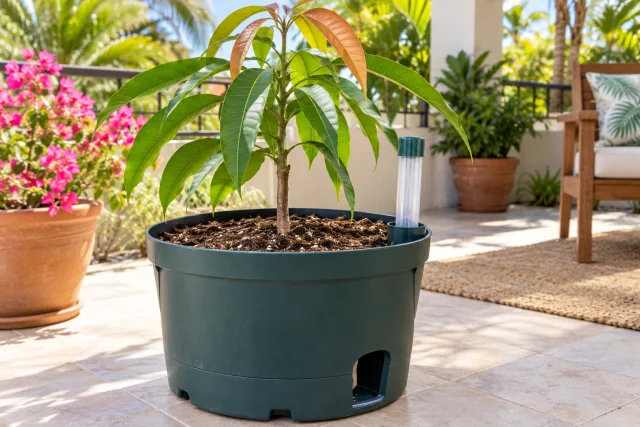
SWP (generated editorial illustration)

SWP

SWP means self-watering planter, a general name for a container with a water reservoir or another automatic water-delivery arrangement. Many designs are also sub-irrigated planters, but the label does not guarantee suitability for a mango. Root aeration, an effective overflow, adequate container volume, and monitoring remain important. Fertilizer salts can accumulate if water repeatedly moves upward without periodic appropriate leaching. Adjust operation to the tree's water use instead of keeping the reservoir full in all seasons.

The reservoir reduces the frequency of filling but does not remove seasonal management. A tree with little active foliage may use water slowly, while a larger canopy can empty the reservoir quickly. Inspect water movement and root-zone moisture together, particularly after repotting or moving the planter into a different light or temperature regime.

Read more about SWP