

This site contains affiliate links for which we may be compensated.

Mango Database
Mangoes in a sunlit tropical orchard

Mango Glossary

Understand the language of mango growing, one term at a time.

Explore Mango Terminology

Browse definitions and growing concepts to expand your mango knowledge.

Showing 1–4 of 4 terms
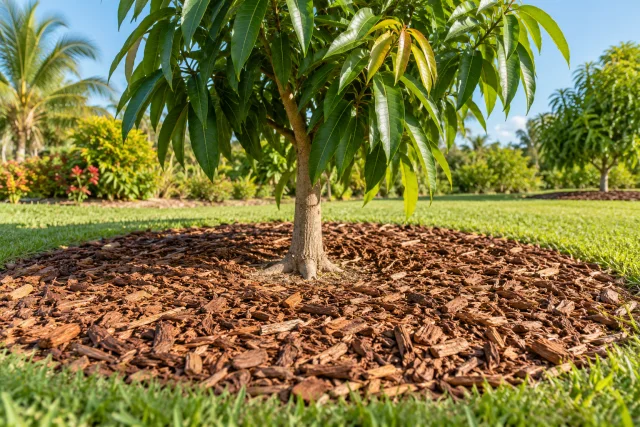
Mulch (generated editorial illustration)

Mulch

Mulch is material placed on the soil surface to moderate conditions and reduce problems such as evaporation and weed competition. Organic mulch around mango trees can support a more protected root zone as it breaks down, but it should not be heaped against the trunk. Keep inspection space around the base and avoid burying the root flare. Mulch does not repair an undrained site, replace all fertilizer, or justify watering without checking soil moisture underneath.

Keep the distinction between a surface covering and an amendment mixed into soil. Their effects on moisture and decomposition occur in different places. Inspect beneath mulch before watering and leave the trunk base accessible, especially where a thick layer could hide accumulated soil, pest activity, or prolonged dampness against bark.
Read more about Mulch

Immobilization

Immobilization incorporates inorganic nutrients into living microbial biomass or other organic forms, temporarily reducing their immediate availability to plants. During decomposition, microbes may use soil nitrogen to process residues that contain relatively little nitrogen. This is different from nutrients being permanently destroyed. In mango care, distinguish surface mulch management from mixing large amounts of fresh, high-carbon material through the root zone, and interpret a growth change using both the material's placement and the wider nutritional conditions.

Immobilization and mineralization can occur in the same soil at the same time in different materials and locations. Their balance changes as residues decompose and conditions shift. A fresh wood-rich amendment mixed into soil presents a different situation from an older surface mulch, so placement and decomposition stage should accompany descriptions of a response.

Further reading: University of Missouri: Mineralization and Immobilization.

Read more about Immobilization

Organic Matter

Soil organic matter includes plant and animal residues at different stages of decomposition, microbial material, and more persistent organic compounds. It influences soil structure, nutrient cycling, and water relations, but is not interchangeable with an undecomposed mulch layer. In mango planting, manage the broader soil environment rather than filling a small hole with a radically different material. A laboratory organic-matter result also does not identify how rapidly that material will release nutrients under local conditions.

Organic matter is a broad pool, not a single uniform fertilizer or substance. Its components differ in persistence and nutrient content, while decomposition changes their contribution over time. A percentage from a soil test provides useful context but does not identify which amendment, quantity, or management practice will best address a specific mango-growing problem.

Further reading: Oregon State University: Soil Organic Matter.

Read more about Organic Matter
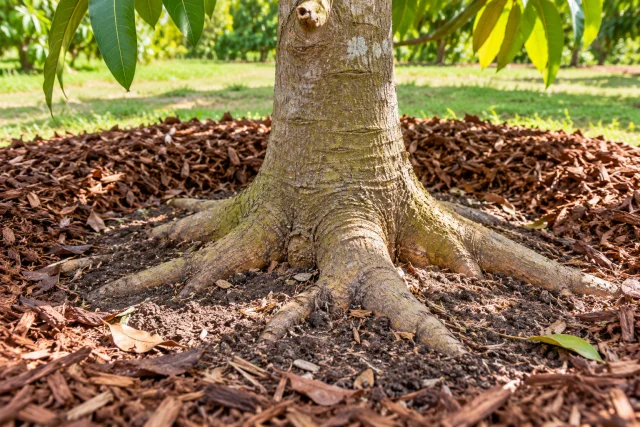
Root Flare (generated editorial illustration)

Root Flare

The root flare is the transition near the base of a tree where the trunk broadens into major roots. Recognizing it helps avoid planting a mango too deeply or piling mulch against the trunk. Nursery media can hide the original position, so inspect the tree rather than assuming the top of the pot always marks the correct ground level. A visible graft union is a different feature, usually higher on the stem, and should not be mistaken for the root flare.

Planting depth should be evaluated relative to the tree's anatomy rather than the container rim. Soil or mulch can accumulate over the flare after planting, and an existing nursery surface may already hide it. Keep the base inspectable, and avoid confusing a swelling at the graft junction with the transition into structural roots.

Read more about Root Flare