This site contains affiliate links for which we may be compensated.
Latest Mango Review
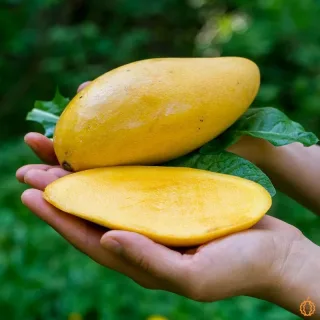
Nam Dok Mai #4
Very nice variety overall. If you like a floral taste on a mango, this is one to have in your collection. I can taste rose/flower and a...
by Rigo · Sep 16, 2025Newest Variety
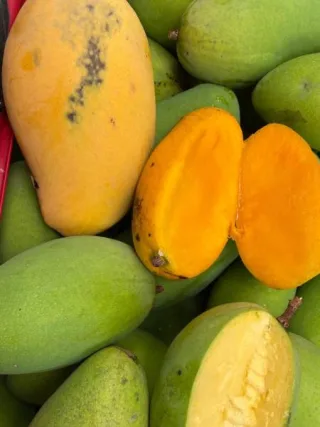
Lemon Zest
Lemon Zest is a modern Florida mango selected through the breeding program of Gary Zill of Zill High Performance Plants in Bo...
View Variety →From Our Blog
View All →
How to Build a Mango Tasting That Teaches More Than a Ranking
Freezing a Mango Harvest Without Losing Track of Quality
Useful Links
- Support Mango Database – Make a Difference
MangoDatabase.com is more than just a website—it’s a community-driven movement dedicated to cataloging, researching, and sharing knowledge about mango varieties from around the world. We strive to provide a free, accessible, and comprehensive resource for mango growers, collectors, and enthusiasts, but we can’t do it alone.
Why Your Support Matters
Creating and maintaining Mango Database requires hundreds of hours of research, data collection, programming, and hosting services. Your financial contributions directly support:
✅ Ongoing Research & Expansion – Ensuring Mango Database remains the ultimate resource for mango enthusiasts worldwide.
✅ Website Development & Hosting – Keeping the platform fast, user-friendly, and constantly evolving with new features.
✅ Community Growth & Engagement – Strengthening connections between mango lovers through interactive tools, educational resources, and community-driven contributions.Your Donation is an Investment in a Growing Movement
By donating, you’re not just supporting a website—you’re fueling a global initiative that will transform the way we document, cultivate, and share mango knowledge for generations to come.
We are at the forefront of an agricultural revolution, bridging the gap between mango history, modern cultivation, and a new era of digital research. Every dollar contributed drives innovation, supports our mission, and strengthens the mango community as a whole.
Ways to Support Mango Database
💛 One-Time Donations – Show your support with a single contribution of any amount. Every donation, big or small, makes a meaningful impact.
💛 Recurring Contributions – Become an ongoing supporter and help sustain Mango Database’s mission with a monthly donation.
💛 Business Sponsorships – Businesses and organizations can contribute by sponsoring giveaways or making direct contributions to Mango Database’s development.Be Part of Something Bigger
Mango Database is built on the power of the people—passionate growers, researchers, and collectors like you who believe in preserving and expanding mango knowledge. Your donation isn't just a gift; it’s a commitment to the future of mango research and an investment in an extraordinary, ever-growing community.
Make a difference today—support Mango Database and help us continue our mission!
- Translations and definitions used for mango varieties or in the mango community
Want to contribute? Send us a message with your info.
Mango in other countries:
kangit (Chuuk, Pohnpei)
idele (Palau)
mago (Niue, Samoa, Tuvalu)
manako (Hawai‘i)
manggo, am (Fiji)
mangko (Kiribati)
mango (English)
mango (Tonga)
mangot, mangue, manguier (French)
mangueira (Yap)
Brahm Kai Meu (Thai) = is a phonetic spelling of the Thai word: Prahmnskaiemii. It is said that roughly translated, it means that the taste is so good even a Brahmin (the Hindu caste of teachers, priests and keepers of knowledge) would give up his wife for a Brahm Kai Meu mango.
Chocanon (Thai) = very lucky
Japprawat (Thai) = emperor (Japprawat was a species for ma-prang (sangaria) but sometimes thai also speak about that for mango). It means it is for the emperor (but they have a king in thailand). The best fruits are for the emperor or king in asian countrys so that is how they get their names.
Keau savoi (Thai) = green eating. Also write as Khiao sawoei, Keo Savoy, Khieo sawoei and even Keow Savoy
Mahanchanok (Thai) = great father (something like a king)
Mun sam ru do (Thai) = 3 seasons
Nam Doc Mai (Thai) = sweet water from flowers or "sweet juice of a flower," alluding to a flower's sweet nectar.
Neelam or Neelum (India) = is a given name, taken from the Sanskrit word for sapphire.
Sam ru du (Thai) = is what thai people call the 3 seasons. Without the Mun in front which I think is blessed with wisdom. It is highly valued in Thailand.
Sia Tong/Si Thong (Thai) = Golden
- Tree management
Q: How can I protect my trees from frost?A: The best way to protect trees is to grow them on frost-free land. You can protect young trees by wrapping their trunks in sisalation or similar insulating material for their first winter. Another method is to irrigate for an hour or two until sunrise, just before frost settling.
Q: Should I hedgerow my new plantings?A: Hedgerowing will depend on tree spacing. Tree spacings of less than 4 m lend themselves well to hedging as opposed to managing wider spaced individual trees.
Q: How tall should I let my trees grow?A: For efficient harvesting and effective spray coverage keep trees less than 4.5 m high.
Q: How and when do I prune?A: Young mango trees should be pruned every one to two flushes to maximise branching and fruiting terminals. When trees reach bearing age, prune them each year to maintain size, thin out the canopy and remove dead wood. Prune by hand with secateurs or machine prune. The main pruning is done after harvest.
Q: When should I fertilise my trees?A: In bearing trees, most fertiliser is applied after harvest. The rest is applied at flowering and early fruit growth. Young trees require regular fertilising every two to three months to encourage continuous, strong growth.
Q: How much fertiliser should I use?A: The amount of fertiliser you use will depend on soil type, tree size and cropping history. Always do a leaf and soil analysis before planning your fertiliser program.
Q: How much gypsum do I need and how often should I apply it?A: Gypsum supplies additional calcium to the plant without changing the pH of the soil. The normal application rate is about 5 t/ha or 500 g/sq.m. Gypsum is normally applied soon after harvest, and before flowering.
Q: How much water do my mangoes need, and when?A: Mangoes are a deep-rooted crop and a mature tree needs a large volume of water. The amount of water required depends on the size of the tree and the time of the year. An orchard's water requirements can exceed 6 ML/ha a year. At peak demand, from fruit set to harvest, a mature tree may need over 2000 L per week.
Q: Why don´t my trees flower?A: Mango trees are sensitive to climatic conditions at flower initiation. They need a dormant period in winter to initiate flowering. Poor flowering can also result from reduced carbohydrate reserves in the tree from a very heavy crop the previous season, or from late pruning.
Q: Why do my trees flower but not set fruit?A: Poor fruit set can be caused by poor pollination due to cold weather at flowering, or fungal diseases such as anthracnose in the flowers. There are also several insects that eat the flowers.
Q: My trees are flowering early when the nights are cold. What should I do?A: Early flowering at this time is difficult to manage. Flowers can be cut off as long as the weather stays cool. Healthy trees will produce new flowers in about six weeks. Remember to cut off just the flower panicle. There is a risk that late flower removal can result in the production of a leaf flush rather than flowers as the weather gets warmer.
Q: Why are my fruit dropping off?A: Mango flowers will set many more fruit then the tree can hold and will have significant fruit drop. Other reasons for fruit falling off include water stress, poor pollination, disease and insect attack.
Q: When are my mangoes ready to pick?A: Fruit that is ready for harvest should have a minimum dry matter of 14% and should be well filled at the beak and shoulders. When the fruit is cut open, the internal flesh is a uniform pale yellow. The internal flesh of immature fruit is white.
- Trusted, Reputable Sellers & Businesses
Green Planet Farms
Tropical acres farm
- Using The Advanced Search Function
Created to be used with ease. Just like the basic search function, but with more details to select from. You can be even more specific using the advanced search function. 1) Select the "Advanced Search" button. This will extend the search menu. 2) Select any of the drop down bar options or bullet options available to conduct your search. 3) Click on the "Search" button and it will show you results according to your selected choices.
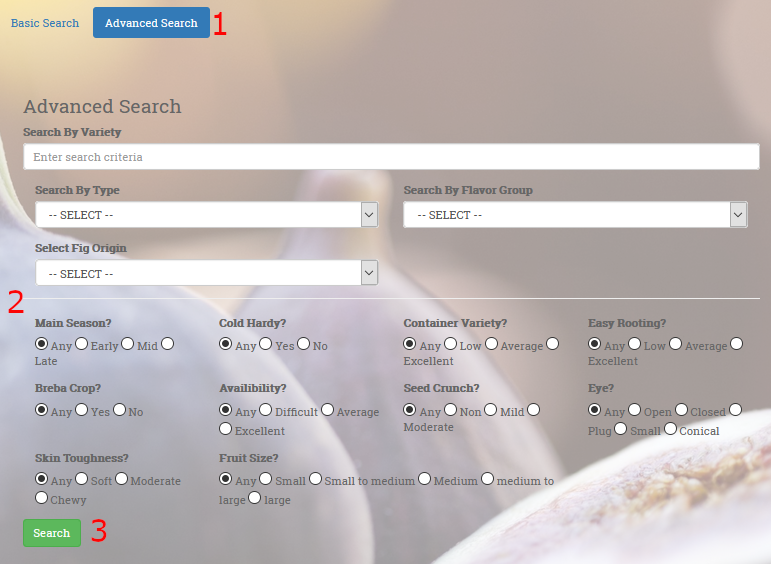
(Picture may show as an example from Fig Database or an older version of Mango Database)You can also combine your selection of options (e.g. selecting Search By Type: Common, Search By Flavor Group: Honey, Cold Hardy: Yes and clicking will redirect you to all varieties currently fitting those selected choices).
- Where To Buy Scions, Trees & Fruits?
- YouTube Channels