This site contains affiliate links for which we may be compensated.

Mango Database
Mangoes in a sunlit tropical orchard

Mango Glossary

Understand the language of mango growing, one term at a time.

Explore Mango Terminology

Browse definitions and growing concepts to expand your mango knowledge.

Showing 106–112 of 197 terms

Mealybugs

Mealybugs are sap-feeding insects often recognized by white waxy coverings or cotton-like masses. On mango they may gather on tender shoots, flower clusters, or fruit and produce honeydew that supports sooty mold. Ants can protect honeydew-producing insects from natural enemies, so inspect for both. Identification matters because shed skins, harmless wax, and other insects can look similar at a distance. Start with close monitoring and appropriate cultural or biological measures instead of applying broad treatments to every white patch.
Read more about Mealybugs

Micronutrient

A micronutrient is an essential element needed by plants in small amounts, such as iron, zinc, manganese, copper, or boron. Mangoes still need these nutrients, but the margin between adequate and excessive supply can be narrow for some elements. Symptoms can reflect poor availability at an unsuitable pH rather than absence from the soil. Identify the likely problem and use appropriate testing or advice instead of assuming that repeated mixed trace-element applications are harmless.

Read more about Micronutrient

Monoembryonic

Monoembryonic describes a seed containing one embryo. In mango, that embryo normally develops through sexual reproduction after fertilization, so its genetic makeup can differ from the mother tree even when the pollen comes from the same cultivar. A seedling therefore cannot be assumed to reproduce the named fruit from which the seed came. Use a verified grafted tree when a particular cultivar is the goal; grow seedlings for experimentation or suitable rootstocks with realistic expectations about variation.

Read more about Monoembryonic
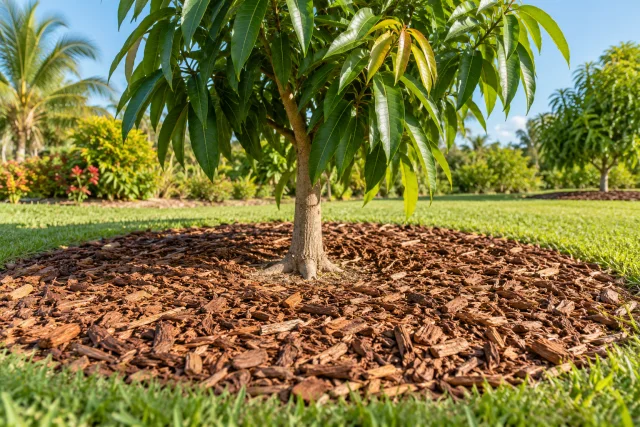
Mulch (generated editorial illustration)

Mulch

Mulch is material placed on the soil surface to moderate conditions and reduce problems such as evaporation and weed competition. Organic mulch around mango trees can support a more protected root zone as it breaks down, but it should not be heaped against the trunk. Keep inspection space around the base and avoid burying the root flare. Mulch does not repair an undrained site, replace all fertilizer, or justify watering without checking soil moisture underneath.

Read more about Mulch

Mycorrhiza

A mycorrhiza is an association between a fungus and plant roots in which the partners exchange resources. Such relationships can influence nutrient uptake and plant performance, but their effects depend on the fungus, host, soil, and management. The general concept does not prove that a purchased inoculant will improve every mango tree. Healthy soil conditions, suitable nutrition, and limited unnecessary root disturbance remain important. Do not treat a commercial microbial product as a substitute for correcting drainage or another clear root-zone problem.

Read more about Mycorrhiza

Newbie

Newbie is an informal name for someone new to a subject, including mango growing. It has the same everyday sense as noob, but is not a horticultural classification. New growers benefit from learning to distinguish seedlings from grafted trees, checking drainage before watering again, and identifying pests before choosing a treatment. When seeking advice, give climate and growing-condition details instead of assuming that a schedule used by another grower will work unchanged in a different location.

Read more about Newbie

NGRP

NGRP stands for National Genetic Resources Program, the USDA program encompassing conservation of genetic resources important to agriculture. Plants are one part of that wider effort, alongside other kinds of agricultural genetic resources. For mango growers, the practical connection is preservation of living diversity and the information needed to use it in research or breeding. NGRP is not a cultivar, certification label, or nursery rating. Its relationship with GRIN and the National Plant Germplasm System explains why those abbreviations often appear together.

Read more about NGRP