This site contains affiliate links for which we may be compensated.

Mango Database
Mangoes in a sunlit tropical orchard

Mango Glossary

Understand the language of mango growing, one term at a time.

Explore Mango Terminology

Browse definitions and growing concepts to expand your mango knowledge.

Showing 141–147 of 197 terms

Precocity

Precocity is a tendency to reach reproductive activity relatively early. In mango descriptions it may refer to a cultivar or a grafted tree that flowers and fruits at a young age under suitable conditions. It is a comparative trait, not a promise of a crop in a fixed year after purchase. A very young tree carrying fruit can also sacrifice establishment and branch development, so early flowering should be evaluated alongside tree strength rather than treated as the only sign of quality.
Read more about Precocity
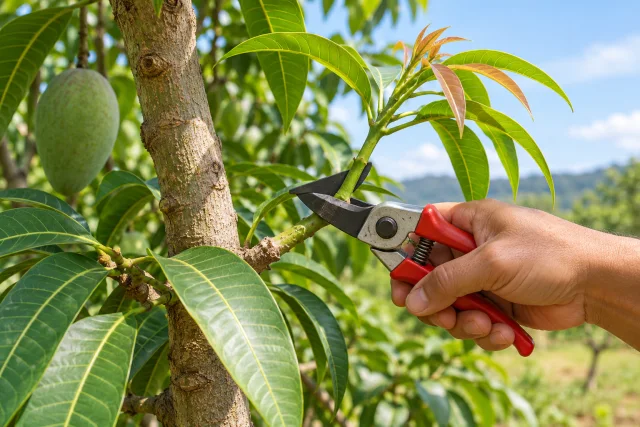
Prune (generated editorial illustration)

Prune

To prune is to remove selected shoots, branches, or other plant parts to improve structure, access, health, or canopy size. Mango pruning often follows harvest so new shoots can develop and mature before the next flowering period, although climate, cultivar timing, and damaged wood can change the decision. Unlike a deciduous tree, mango should not automatically be pruned according to a winter-dormancy rule. Use deliberate cuts and avoid severe, repeated topping that removes productive canopy.

Read more about Prune

Quarantine

Plant quarantine comprises measures intended to prevent introduction or spread of regulated pests. Mango fruit, seed, scions, or trees may face different movement conditions depending on origin, destination, and pest status. A small personal parcel or a trade between friends is not automatically exempt. Consult the relevant plant-health authority before moving material and keep required records. This glossary definition explains the concept rather than providing current legal permission to transport mangoes across a particular border.

Read more about Quarantine
Recalcitrant Seed (generated editorial illustration)

Recalcitrant Seed

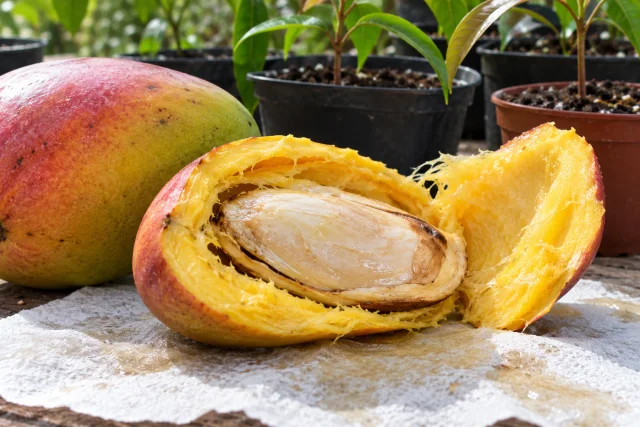
A recalcitrant seed is sensitive to substantial drying and does not tolerate ordinary dry, frozen seed-bank storage. Mango seed belongs to this general category, which helps explain why freshly handled seed is normally preferable to old, dried seed for propagation. This is different from a hard seed coat that merely delays germination. Protect the living embryo from drying and damage, but do not confuse moisture protection with keeping it in stagnant conditions that encourage decay.

Read more about Recalcitrant Seed
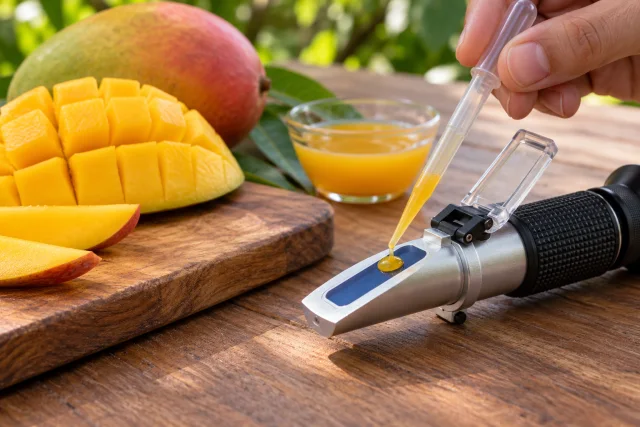
Refractometer (generated editorial illustration)

Refractometer

A refractometer measures how light bends through a sample and can estimate soluble solids in mango juice on a Brix scale. Clean optics, calibration, temperature compensation, and consistent sampling improve comparisons. The reading is influenced by dissolved substances other than sugars, so it is not a complete flavor analysis. A useful tasting record combines the instrument reading with ripeness, acidity, aroma, and texture rather than using one number to rank every mango or identify a cultivar.

Read more about Refractometer

Respiration

Respiration is the process by which living tissues use stored compounds and oxygen to release energy, producing carbon dioxide and water. Harvested mangoes remain alive and continue respiring as they ripen. Temperature and fruit condition influence the rate, which helps explain changes in storage life and the need for suitable handling. Slowing respiration is not the same as stopping deterioration, and enclosing fruit without adequate gas exchange can create off-flavors or injury instead of preserving quality.

Read more about Respiration
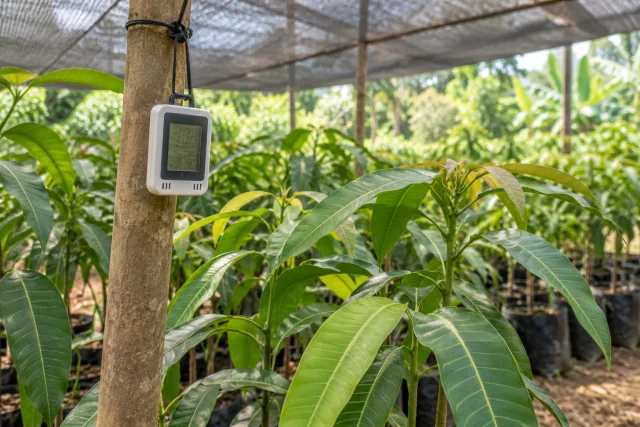
RH (generated editorial illustration)

RH

RH means relative humidity: the amount of water vapor in air expressed as a percentage of the amount the air could hold at that temperature. It affects water loss from mango leaves, drying of flower clusters, and moisture loss from harvested fruit. High RH does not necessarily mean surfaces are wet, but condensation or prolonged leaf wetness can favor disease. Consider temperature, ventilation, and actual surface moisture together rather than using one humidity reading as a disease diagnosis.

Read more about RH