This site contains affiliate links for which we may be compensated.

Mango Database
Mangoes in a sunlit tropical orchard

Mango Glossary

Understand the language of mango growing, one term at a time.

Explore Mango Terminology

Browse definitions and growing concepts to expand your mango knowledge.

Showing 148–154 of 197 terms
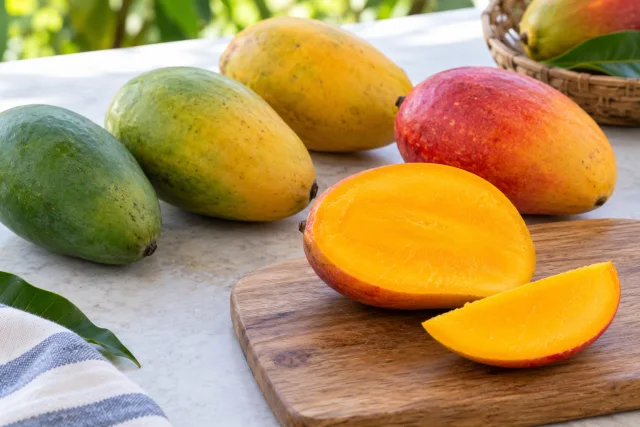
Ripening Stage (generated editorial illustration)

Ripening Stage

Ripening stage describes how far a fruit has progressed toward its characteristic eating quality. In mangoes, firmness, aroma, flesh texture, and internal color change during ripening, while peel color can be a poor guide for some cultivars. Harvest maturity and eating ripeness are different: a mature but firm fruit may ripen successfully after picking. Describe the actual condition of the fruit when comparing flavors or storage results, because a cultivar sampled too early can give a misleading impression.
Read more about Ripening Stage

RKN

RKN stands for root-knot nematode, a group of microscopic plant-parasitic roundworms in the genus Meloidogyne. They feed in roots and can cause swellings or galls, reducing effective root function in susceptible plants. Above-ground symptoms such as weak growth are not diagnostic because many root problems look similar. For a mango with suspect roots, use a plant-diagnostic or nematode test and obtain clean nursery material; not every soil nematode is harmful or requires treatment.

Read more about RKN
Root (generated editorial illustration)

Root

A root is a plant organ that anchors the tree, absorbs water and dissolved nutrients, and stores reserves. Mango roots include larger structural roots and finer absorbing roots, whose distribution changes with soil depth, drainage, irrigation, and obstacles. Roots need oxygen as well as moisture, so saturated soil can leave a tree wilted even when water is abundant. Protect the root zone from compaction, trenching, and fertilizer buildup rather than assuming all growth problems begin in the leaves.

Read more about Root
Root Bound (generated editorial illustration)

Root Bound

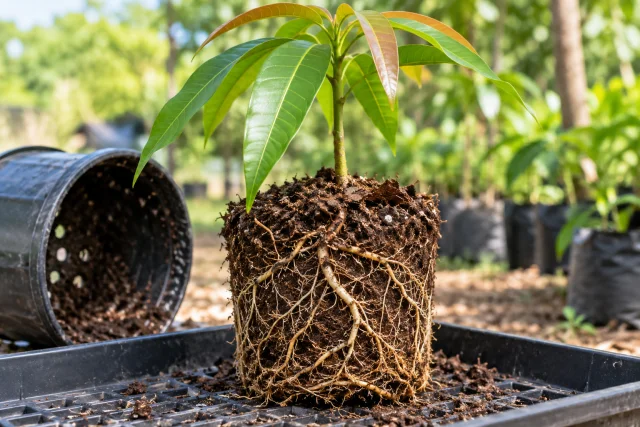
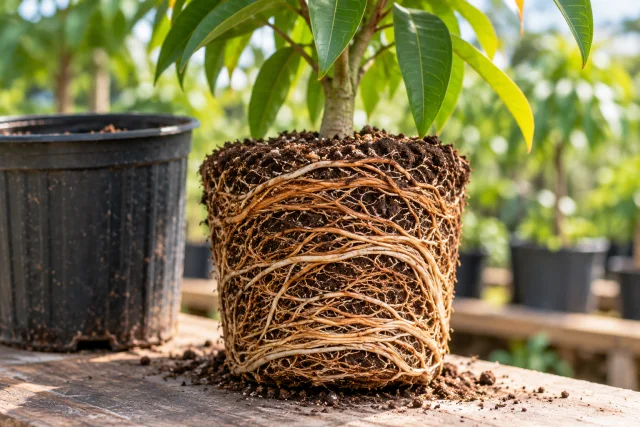
Root bound describes a container plant whose roots have become crowded, often circling the pot or forming a dense outer mass. A tall mango in a small container may have this problem even when its leaves look healthy. Root arrangement can affect later establishment and stability, so inspect nursery stock before buying. Repotting is not just placing the intact dense mass in more wet medium; handling decisions should account for root condition without causing unnecessary damage to a sensitive young tree.

Read more about Root Bound
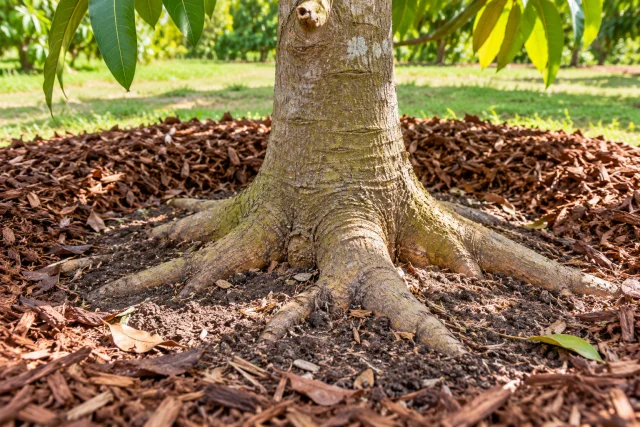
Root Flare (generated editorial illustration)

Root Flare

The root flare is the transition near the base of a tree where the trunk broadens into major roots. Recognizing it helps avoid planting a mango too deeply or piling mulch against the trunk. Nursery media can hide the original position, so inspect the tree rather than assuming the top of the pot always marks the correct ground level. A visible graft union is a different feature, usually higher on the stem, and should not be mistaken for the root flare.

Read more about Root Flare
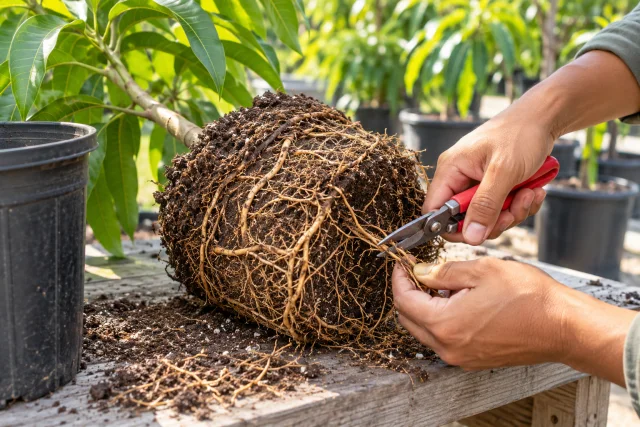
Root Pruning (generated editorial illustration)

Root Pruning

Root pruning is the deliberate cutting of roots to alter a plant's root system or fit it into a managed container. For mango, it can also create significant stress, reduce water uptake, and compromise stability if structural roots are damaged. It should not be presented as a routine or universally safe method of forcing flowering. Container work requires particular care with timing and aftercare; cutting roots of a large landscape tree warrants specialist advice rather than experimentation near the trunk.

Read more about Root Pruning
Rooting

Rooting

Rooting is the formation and development of roots. The word can describe a germinating mango seed, new roots after transplanting, or attempts to propagate a cutting, but those are different processes with different success rates. Mango is commonly multiplied by grafting onto seedling rootstocks because ordinary cuttings are not reliably easy to root. New leaf growth alone is not proof that a detached cutting has a working root system. Evaluate roots and sustained growth before treating it as established.

Read more about Rooting